




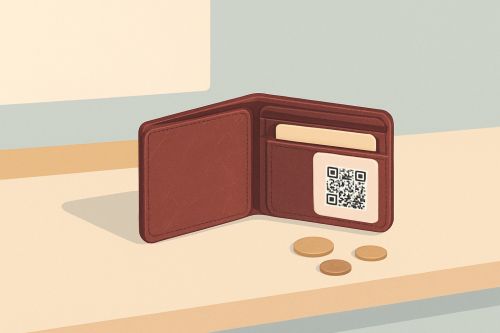
Showing a card at the pharmacy counter, so the next question comes more simply, without having to explain anything
A laminated card taken out of the wallet at the pharmacy counter, and the shopkeeper or doctor adjusts their question without it needing to be repeated twice. The person keeps their independence for everyday tasks, without an occasional memory lapse turning into misunderstanding.
This case involves a 74 year old person with early-stage Alzheimer's, recently identified, still independent for shopping and appointments, but sometimes caught off guard by a question asked too quickly or a string of instructions.
The moment, as it happened
Behind the counter, the pharmacist closes the drawer of paracetamol boxes and hands the prescription to Georgette, 74, who has come for her monthly refill. She asks if Georgette took her blood pressure reading this morning, a routine question she asks every client over sixty. Georgette hesitates, searches for the answer, the question blurs, she no longer knows whether to answer about her blood pressure or the dosage of her treatment.
Georgette then takes out of her wallet a laminated card she always keeps next to her health insurance card. The pharmacist scans the QR code printed on the back and learns in a few lines that early-stage Alzheimer's sometimes makes it hard to follow several questions in a row, and that it is better to ask them one at a time, in order. She immediately rephrases: first the blood pressure, then the treatment, one question after another.
Georgette answers without becoming more confused, the queue behind her did not have time to grow impatient, and no one raised their voice to be understood. No call to her daughter was needed to clarify a point about her treatment, and the pharmacist simply adjusted the way she asked her questions, without ever pointing out the confusion out loud.
- You write it
- The QR is in place
- The reader scans
- Understood, without explaining again
Where to place the QR code for this case
A person with early-stage Alzheimer's often remains independent for outings, which makes the card more suitable than a fixed label on clothing. The goal is for them to keep control over when they show it.
- Laminated card slipped into the wallet, next to the health insurance card, shown only if a question becomes hard to follow.
- Label on the diary or appointment book, printed from a standard A4 sheet of labels, useful for a doctor seen occasionally.
- Stamp on the back of the chequebook, discreet, for a regular shopkeeper who notices unusual hesitation when paying.
- Link shared with the regular pharmacy, saved once in the customer file, so the team already knows the situation without starting from scratch each visit.
The rule to keep in mind: the card stays in the person's hand, they decide whether or not to show it, and no one else makes that decision for them.
Ready-to-use text templates
Three templates to adjust to your loved one's situation. They cover what a shopkeeper or caregiver reads first: who is speaking, how to ask a question without rushing them, and what unnecessarily complicates the exchange. Starting points, not sentences to copy word for word.
For the "About me" section
"My name is [first name], I am [age] years old. I have recently been diagnosed with early-stage Alzheimer's. I remain independent for my shopping and appointments, but a question asked too quickly or several pieces of information in a row can make me lose track."
For the "How to help" section
"You can: ask one question at a time rather than several in a row, give me time to answer without immediately following up, rephrase simply if I don't answer right away, and speak directly to me rather than to the person accompanying me."
For the "What to avoid" section
"To avoid: asking several questions in a row without a pause, raising your voice thinking I can't hear, talking about me to a third person present as if I weren't there, or visibly losing patience if I take time to answer."
Conditions related to this case
This case involves early-stage Alzheimer's, which does not prevent day-to-day independence but sometimes makes it harder to process several pieces of information given in a row. Asking one question at a time, without rushing, is often enough to avoid confusion. The linked page details how this works and the helpful supports for everyday interactions with a shopkeeper, a doctor, or a pharmacist.
Similar cases
Other situations where an elderly person remains independent for everyday tasks, but where a card tucked into a wallet helps an occasional contact adjust the way they ask a question, without the family having to step in every time.
In case of wandering or disorientation, someone can access the emergency information and the family's contacts.
View the caseThe person can get help without having to explain out loud what they cannot put into words.
Care staff reach the key information (treatments, contacts) without waiting for the family.
Prepare your profile for this situation, without having to explain it again every school year.
You write down the essentials once. The grading teacher, the AESH (a teaching assistant for students with disabilities, in France), the substitute scan and understand. You stop repeating yourself.