






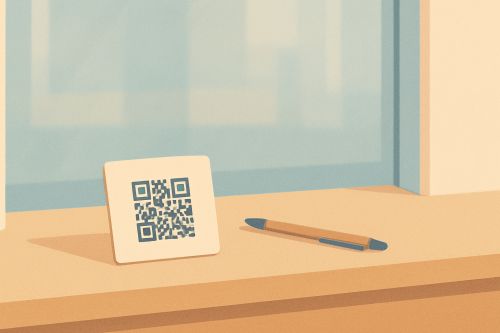
Hand over a card in silence, and let the other person understand that you take everything in, but your voice is blocked
A wallet-sized card handed over in person the moment the voice freezes, and the professional you are dealing with understands within seconds. No need to force out a word, no need to seem rude.
This case is about an adult with selective mutism, who speaks normally in some settings (family, close friends) but whose voice freezes in front of strangers, in professional or administrative contexts.
The moment lived
Tuesday, 2pm, an appointment with your bank advisor. You walk through the door. The voice shuts down, as it always does. You smile, you hand over the card you have prepared. The advisor understands this is not rudeness.
He scans the QR code. He reads within seconds: "Selective mutism. I understand everything. I prefer that you talk to me in writing or ask me closed (yes/no) questions. You can also write things down on paper." He nods.
The meeting takes place in writing, on a shared notepad. You answered all of his questions. No one raised their voice, no one sighed. You left with your loan approved, and your voice coming back once you were outside.
- You write it
- The QR is in place
- The reader scans
- Understood, without explaining again
Where to place the QR code for this case
The goal: that the card is within reach in risky situations (administrative, medical, professional appointments), ready to be handed over without having to search for it.
- A bank-card sized card in the front pocket of the wallet, so it can be taken out in one move.
- A second card in the coat pocket for winter appointments.
- A QR label stuck on the back of the phone, to show discreetly when you are already holding the screen.
- A QR link shared in advance by email for important appointments (job interview, specialist medical appointment).
The rule: that handing over the card is smooth, with no time spent searching, so it does not add stress to an already tense moment.
Pre-written text templates
Three outlines to explain selective mutism to someone who is not familiar with it, without a long speech.
For the "About" section
"I have selective mutism. It is not shyness or a whim: my voice is physically blocked in certain contexts, even though I understand perfectly everything you say to me. I speak normally in other situations."
For the "How to help" section
"What works well: talking to me in writing (paper, phone, tablet), asking me closed (yes/no) questions I can answer with a nod, giving me time. I can point, write, sign a document."
For the "What to avoid" section
"What to avoid: asking me to repeat out loud, telling me "come on, make an effort", raising your voice, reading my silence as a refusal or as rudeness, assuming that I do not understand the conversation."
Conditions covered
Selective mutism is central here. It often sits within a broader anxiety condition, sometimes linked to an autism spectrum condition.
Similar cases
Three other situations where a card prepared in advance defuses a moment of impossible communication.
The teacher understands the atypical social behaviours and can pass the useful information on to the teaching team.
View the case High-school student with ADHD, age 17 Reader: Tutor teacher, school liaisonThe tutor understands the organisation difficulties and can suggest concrete accommodations for exams.
View the case Adult with ADHD, age 34 Reader: New colleague, managerThe person chooses when and to whom they explain how they work, in their own words, without having their lapses misread.
View the casePrepare your profile for this situation, without having to explain it again every school year.
You write down the essentials once. The grading teacher, the AESH (a teaching assistant for students with disabilities, in France), the substitute scan and understand. You stop repeating yourself.