






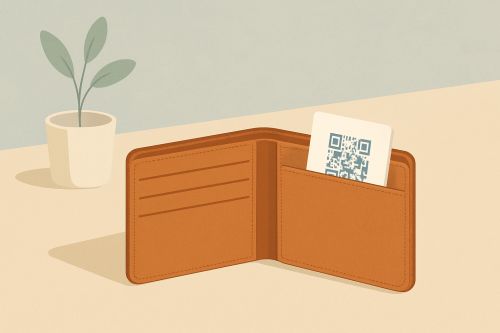
Take out a card prepared in advance, and stop a silence from blocking an appointment at the doctor's or at a counter
A card slipped onto the counter before the question is asked out loud, and the doctor or administrative officer understands at a glance why the answer will not come verbally that day. The appointment continues without a follow-up push, without an awkward blank, with the useful information already written down on paper.
This case concerns an adult with selective mutism, who sometimes gets stuck on speaking when facing an unfamiliar person or in a formal setting. He wants a doctor or administrative officer to have a card to read right away, rather than a silence that drags on.
The moment that matters
Tuesday, 10 a.m., civil registry desk at the town hall. Camille, in her thirties, waits her turn for an address change on her ID card. The officer calls her to counter 4, asks a first routine question. Camille's throat tightens, as it does every time she faces a stranger in a formal setting: no sound comes out, even though she knows exactly what to answer.
Except that Camille prepared, before coming, a card slipped into her card holder. She places it on the counter without a word, with the link to her profile printed on the back. The officer scans the code on his personal phone, during his break. He reads the essentials there: Camille lives with selective mutism, she understands everything and can write her answers, but her voice sometimes locks up when facing a stranger or in an official setting.
The process moves forward normally: the officer asks his questions out loud, Camille answers by pointing or writing in a notebook she always carries with her. What did not happen: the insistent look waiting for an answer that does not come, the question repeated louder as if she had not heard, and the feeling, on leaving, of having had to justify herself for a simple address change.
- You write it
- The QR is in place
- The reader scans
- Understood, without explaining again
Where to place the QR for this case
Facing a counter or a medical office, the QR must be ready before the question is asked, not pulled out in a rush once the silence has already set in. The key is to always have it on hand, in a format that comes out in one motion.
- Card slipped into the card holder or wallet, placed on the counter from the first question, with no need to search for it.
- Label on the notebook used to write answers, printed from an A4 sheet of labels (standard template), so the other person understands the notebook's purpose at a glance.
- Link sent by message before a scheduled appointment, so the doctor or the front desk knows about it before arrival.
- Laminated card in the ID document sleeve, ready to accompany any document already shown at the counter.
The rule here: the card always goes out before the question, not after the silence. It is what opens the exchange, not the other way around.
Pre-written text templates
Three templates to adjust to your situation. They cover what a doctor or administrative officer reads first: what selective mutism is, what helps move the exchange forward, and what blocks everything. Starting points, not sentences to copy word for word.
For the "Introduction" section
"My name is [first name]. I live with selective mutism: I understand everything said to me and I can write my answers, but my voice locks up when facing a stranger or in a formal setting like this one. This is neither shyness nor a refusal to cooperate."
For the "How to help" section
"You can: ask your questions normally out loud, let me answer in writing or by pointing on this card, keep your usual pace without slowing down excessively, continue the exchange as with any other visitor, and give me a little time before moving on to the next question."
For the "What to avoid" section
"To avoid: repeating the question louder thinking I did not hear, demanding an immediate spoken answer, addressing a companion instead of me, commenting on my silence in front of other people present, or growing impatient if I take time to write my answer."
Conditions concerned by this case
This case relates to selective mutism: an inability to speak in certain specific social situations, while speech remains possible elsewhere, for example at home. When facing a stranger or in a formal setting, the block has nothing to do with understanding or willingness to cooperate. The linked page details this way of functioning and the supports that make exchanges easier.
Similar cases
Other administrative or medical appointments where a card prepared in advance prevents a misread silence from complicating an otherwise simple process.
The teacher understands the atypical social behaviours and can pass the useful information on to the teaching team.
View the case High-school student with ADHD, age 17 Reader: Tutor teacher, school liaisonThe tutor understands the organisation difficulties and can suggest concrete accommodations for exams.
View the case Adult with ADHD, age 34 Reader: New colleague, managerThe person chooses when and to whom they explain how they work, in their own words, without having their lapses misread.
View the caseNo need to explain it to every new person.
Three texts (introduction, how to help, what to avoid), one shared QR code. When they scan it, the person reads what they need to know, in their own language.