






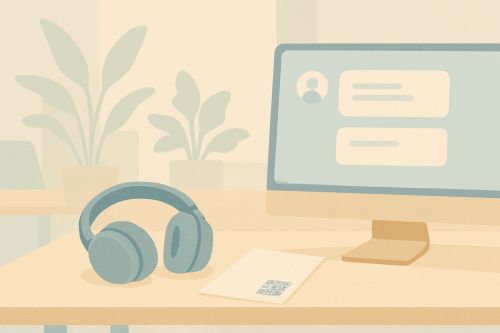
The headphones on the ears are not a barrier: explaining it to the open-plan office in a single message
A link sent once to the project team, and the noise-cancelling headphones take on a new meaning in the eyes of colleagues: it is no longer a closed door, it is a filter for coping in a space saturated with noise and light. The shared work goes on, without the need for quiet being taken for coldness.
This case concerns a 45-year-old adult who lives with sensory hypersensitivity and works in an open-plan office. He wants his desk neighbours to have a simple point of reference, rather than letting every pair of earbuds or every avoided room be read as withdrawal.
The moment that matters
Three in the afternoon, the peak of the day in the open-plan office. An impromptu discussion opens up right next to Marc's desk, 45 years old, three overlapping voices, the coffee machine hissing, the harsh light from the glass wall. To stay on his current task, he pulls his noise-cancelling headphones up over his ears. Two metres away, a colleague who joined recently reads something else into it: Marc is isolating himself, he is not playing along with the team.
Except that Marc shared, a few days earlier, a link to his profile by email with the project team. The colleague opens it, curious. In a few lines, he reads what Marc laid out himself: a sensory hypersensitivity, a brain that saturates quickly when noise and light pile up, headphones that are not a wall but a filter to stay focused, and the fact that a written message always lands better than being called out in the din. Nothing intimate, just what helps in working side by side.
In the following days, when the open-plan office grows louder, no one takes the headphones as an affront. Before the next long workshop, a colleague books the back room, the quietest one, without Marc having to ask. He takes full part, makes suggestions, decides. What did not happen: the whispered "he's odd" between two desks, the charge of lacking team spirit, and the fatigue of having to justify himself every time he protects his attention.
- You write it
- The QR is in place
- The reader scans
- Understood, without explaining again
Where to place the QR for this case
Here, the QR does not need to be displayed for the whole floor to see. It goes to the people who share the space day to day, those whose word or gesture changes the day, and it stays available at the moment the question comes up.
- Link shared by email with the project team, sent in a calm moment, so that each person can open it at their own pace rather than in the middle of a meeting.
- Wallet-sized card kept on hand, passed along during a one-to-one exchange with a close colleague or the manager.
- Discreet label on the headphones or the screen, printed from an A4 sheet of labels (standard template), as a silent point of reference for desk neighbours.
- Link in the internal email signature, that each contact can open without any step or direct question.
The rule here: the information goes to those who share the workspace, not to the rest of the company. The QR sets a context with the right people, it exposes nothing beyond the useful circle.
Pre-written text templates
Three outlines to adjust to your situation. They open the sections a colleague reads first: what sensory hypersensitivity changes at the office, what really helps, and what makes the fatigue worse. Starting points, not sentences to copy as they are.
For the "Introduction" section
"My name is [first name], I work as a [role]. I have sensory hypersensitivity: noise, light and saturated spaces tire me out much faster than average. My headphones or earbuds are a filter to stay focused and available, not a way of cutting myself off from the team."
For the "How to help" section
"You can: let me know before starting a discussion right next to my desk, favour a quiet room for long meetings, write to me rather than call out to me over the noise, accept the headphones without commenting on them, and lower a blind when the light gets strong."
For the "What to avoid" section
"To avoid: reading the headphones as a rejection, opening an impromptu brainstorm in the surrounding din, commenting on my sensitivity in front of others, seating me by default in the noisiest spot, or taking my need for quiet as a lack of involvement."
Conditions relevant to this case
This case relates to sensory hypersensitivity: a system that processes sounds, light and atmospheres with unusual intensity, to the point of saturation. It sometimes exists on its own, sometimes alongside another way of functioning, but here it is the sensory experience at work that counts. The linked page details what is at play and the supports that soothe the environment.
Similar cases
Other work contexts where a signal set once, to the right circle of colleagues, is worth more than letting a behaviour be read on its own, day after day.
The teacher understands the atypical social behaviours and can pass the useful information on to the teaching team.
View the case High-school student with ADHD, age 17 Reader: Tutor teacher, school liaisonThe tutor understands the organisation difficulties and can suggest concrete accommodations for exams.
View the case Adult with ADHD, age 34 Reader: New colleague, managerThe person chooses when and to whom they explain how they work, in their own words, without having their lapses misread.
View the case