






Give the substitute teacher your autistic child's triggers and routines from the very first hour, without pointing them out in front of the class
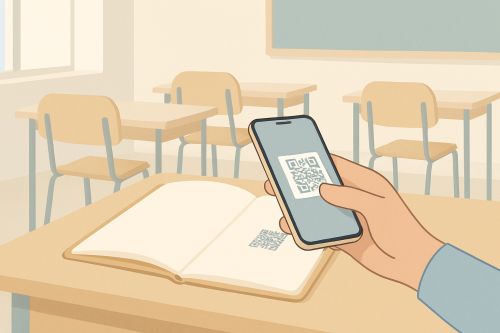
A QR code slipped into the home-school notebook, and the substitute teacher knows your autistic child's sensory triggers and routines before even taking the register. No need for a last-minute written handover, nor to single the child out in front of the class to explain their needs.
This case is about an autistic child (autism spectrum condition, level 1) attending a mainstream class, whose parents want an occasional substitute, often notified the day before, to immediately have the information that prevents a day of crisis.
The moment lived
Thursday, 8.20am. The usual teacher is away, a substitute arrives with no file, notified the previous evening. He does not know the class, your child, or the fact that an unannounced change to the timetable can trigger a rise in anxiety late in the morning.
As he goes to fill in the home-school notebook, he comes across the QR label stuck on the inside front page. He scans it. Within two minutes, he reads the essentials: the noise of the canteen is a trigger, a quiet corner is often enough to defuse things, warning of a change in advance prevents a crisis, and instructions land better in writing than spoken.
The morning goes by. No crisis at the move to the canteen, because the substitute gave warning five minutes ahead. No telling-off for misread behaviour, no urgent call to the parents, no child singled out in front of the others. In the evening, you read the notebook: everything went normally.
- You write it
- The QR is in place
- The reader scans
- Understood, without explaining again
Where to place the QR code for this case
The goal: that the QR code is where any adult who takes the class is bound to look, the regular teacher as much as the last-minute substitute, without you having to give a heads-up every time.
- Home-school notebook: a label stuck on the inside front page, the place every adult checks at the start of the day.
- A4 sheet of labels (standard model) printed at home, to stick the same QR code on the notebook, the pencil case and the folder.
- Laminated card given to the head teacher at the start of the year, so she can pass it on to any substitute.
- Pupil welcome sheet, with the QR code built in, slipped into the class binder available to the team.
The rule: redundancy across the materials the substitute will open anyway. A label in a binder that is never opened is of no use.
Pre-written text templates
Three starter outlines to help an adult who does not know your child quickly get into their daily life. To be adapted to their age and profile, not copied as is.
For the "About" section
"[First name] is [age], he is autistic (autism spectrum condition). He understands instructions, but noise, the unexpected and unannounced changes to the timetable can put him in difficulty. Three things to know first: [main trigger], [what soothes him], [the way he communicates when he is overwhelmed]."
For the "How to help" section
"You can: warn in advance of any change of activity or schedule, offer a quiet corner when the noise level rises, give instructions in writing or with a visual aid, allow a transition time before moving on to something else."
For the "What to avoid" section
"What to avoid: forcing eye contact, sending him to the front of the class without warning, raising your voice when he freezes (this worsens the overload), reading a withdrawal or rocking as insolence, rushing him during a transition."
Conditions involved
Autism (autism spectrum) is at the heart of this case. When it comes with marked sensory hypersensitivity or an attention difficulty, the adjustments offered to the substitute teacher often add up.
Similar cases
Three other situations where an adult at the school, whether the regular staff member or a substitute, picks up the essentials with no written handover and no prior meeting.
The teacher understands, right when marking, why the handwriting is difficult, without the child having to ask out loud for leniency.
View the case Child with ADHD, age 11 Reader: AESHThe support assistant has the right strategies from day one, with no trial and error and no extra meeting.
View the case Child with dyslexia, age 14 Reader: Subject teacherEvery teacher understands the useful accommodations without the student having to ask for them out loud in every class.
View the case