






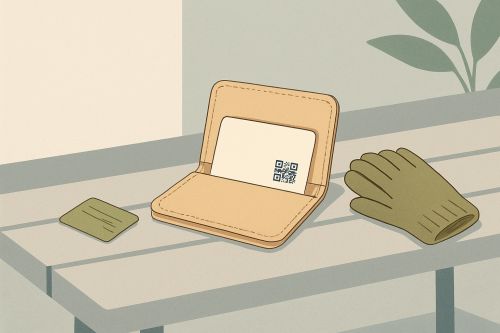
When a checkout breaks down, a card held out in silence tells the security guard to help, not to question
A card slipped into a wallet, and a supermarket security guard or receptionist knows to rephrase a question instead of repeating it louder. The person stays in control of the situation, with no need for a relative to step in remotely to sort out an ordinary mishap.
This case concerns a 22 year old adult with a cognitive disability, independent for everyday outings but sometimes caught off guard by an unexpected hitch (a broken machine, a misunderstood question) that he cannot explain out loud in the moment.
The moment as it happened
The red light flashes above the self checkout before Antoine has even finished scanning his shopping. An unrecognized item blocks the basket from being validated, an ordinary Thursday, in the supermarket he has visited every week since moving out on his own. Antoine freezes, his hand on the bag of apples, unable to find the words to explain to the guard what just happened.
The guard steps closer, notices how long he has stood still and how his gaze avoids contact, and repeats the question a second time, a little louder. Antoine then takes out a laminated card he always keeps next to his bus pass, and holds it out without a word. The guard scans the QR code printed on the back: the card mentions a cognitive disability and asks that instructions be rephrased one at a time, without raising the voice or repeating the same sentence louder.
The guard calls a colleague to clear the checkout and rephrases the question in one short sentence. Antoine answers, completes his payment, and leaves with his bags. No crowd gathered behind him, no staff member raised their tone thinking he refused to answer, and his guardian received no call to come sort things out in his place.
- You write it
- The QR is in place
- The reader scans
- Understood, without explaining again
Where to place the QR code for this case
An adult with a cognitive disability often keeps his independence for everyday outings, which makes a card more suitable than a fixed label: it stays in his hand, and he decides when to show it.
- Laminated card slipped into the wallet, next to the bus pass or health insurance card, shown only if a situation becomes hard to follow.
- Label on the backpack, printed from an A4 sheet of labels (standard template), noticeable to a receptionist without having to search the bag.
- Stamp inside the diary or appointment book, discreet, for a familiar colleague who notices an unusual hesitation.
- Link shared with the residential home or support service that follows the person, recorded once in his file, so the team already knows the situation without starting from scratch.
The rule to remember: the card stays in the person's own hand, he decides whether to show it or not, without the guardian or a carer making that decision for him.
Pre-written text templates
Three templates to adjust to your relative's situation. They cover what a security guard or receptionist reads first: who is speaking, how to rephrase an instruction without raising the voice, and what makes the exchange harder. Starting points, not sentences to copy word for word.
For the "About me" section
"My name is [first name], I am [age] years old. I have a cognitive disability: I understand what I'm told, but I sometimes need an instruction rephrased simply, one at a time, and enough time to answer, without it being repeated louder or with impatience."
For the "How to help" section
"You can: speak directly to me rather than to the person accompanying me, rephrase a question in simple words if I don't answer right away, give me time to answer, and offer help rather than making me guess it's available."
For the "What to avoid" section
"To avoid: repeating the same sentence louder thinking I can't hear, addressing someone else present as if I weren't there, showing visible impatience if I take time to answer, or deciding for me without asking my opinion."
Conditions covered by this case
This case concerns a cognitive disability that does not prevent everyday independence, but sometimes complicates an unexpected event or a poorly phrased instruction. Rephrasing simply, one step at a time, is often enough to unblock the situation. The linked page details how this works and the support that helps in exchanges with a stranger, outside the familiar circle.
Similar situations
Other situations where an adult stays independent day to day, but where a card slipped into the wallet helps an unfamiliar person adjust how they address him, without the family having to step in every time.
The other person understands the situation right away and adapts how they communicate, without the person having to explain what they can no…
View the case Older adult with Alzheimer's, 78 years old Reader: Passerby, policeIn case of wandering or disorientation, someone can access the emergency information and the family's contacts.
View the case Older adult with early dementia, 81 years old Reader: Emergency services, on-call doctorCare staff reach the key information (treatments, contacts) without waiting for the family.
View the caseNo need to explain it to every new person.
Three texts (introduction, how to help, what to avoid), one shared QR code. When they scan it, the person reads what they need to know, in their own language.