






In the gym, give the PE teacher what they need to adapt the effort, before your dyspraxic child feels left out
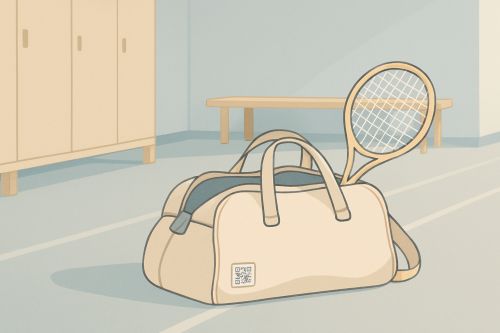
A discreet label on the sports bag, and the QR code leads to a short profile. The P.E. teacher reads it before the warm-up, offers an alternative version of the movement, and your child joins the activity without having to say out loud that their body doesn't keep up.
This case involves a 12-year-old with dyspraxia, at the age where secondary school multiplies team sports and technical movements. The parent wants every P.E. teacher to have the right reference points, with no appointment and no repeated justification.
The moment in class
Tuesday, 10 a.m., the school gym. On the program, throwing and catching a ball in pairs. The others move through it quickly. Tom, though, sets up his movement, anticipates the trajectory, and the ball slips away from him one time out of two. A few laughs break out at the back. The teacher, who doesn't know the class yet, hesitates: lack of attention, or lack of effort?
On Tom's sports bag, a laminated label carries a QR code and the note "scan to adapt". The teacher scans it between two drills. The profile fits in a few lines: Tom has dyspraxia, planning a precise movement costs him a great deal, he does better when the movement is broken down and when he has time to try without an audience. In two minutes, the setup changes: Tom takes on a referee role at one station, then works on catching against the wall, alone, before coming back to playing in pairs.
No comment in front of the group, no "focus" tossed off in passing, no being set aside either. Tom had nothing to explain, and he finished the class in the activity, not on the bench. That evening, no message to write to the teacher to repair a humiliation.
- You write it
- The QR is in place
- The reader scans
- Understood, without explaining again
Where to place the QR code in this case
In P.E., equipment moves around and the child doesn't always have their schoolbag nearby. The idea is to put the QR code on what follows the student to the gym, so the teacher can scan it directly, at the moment of forming groups.
- Label on the sports bag, printed from an A4 sheet of labels (standard template), in a spot that's visible when the bag is leaning against the wall.
- Wallet-sized card slipped into the pencil case or bag pocket, handed personally to the teacher at the start of the year.
- Label on the water bottle or personal racket, the equipment the student takes out anyway every session.
- Link shared by message with the lead teacher, who passes it on to the P.E. team before the first sports cycle.
The rule here: the QR code should be where the teacher is already looking, not become an extra step. It doesn't signal an exemption, it opens an adaptation.
Pre-written text templates
Three drafts to reuse and adjust with your child. They cover the sections the P.E. teacher opens first: who the student is, how to help them during effort, and what puts them in difficulty. Starting points, not sentences to copy as they are.
For the "Introduction" section
"I'm [first name], I'm [age]. I have dyspraxia: my brain takes longer to organize movements, especially fast or new ones. I understand the instruction, but coordinating my body takes a lot of energy. In sport, it shows more than elsewhere, even when I try hard."
For the "How to help" section
"You can: break the movement down into simple steps, let me try off to the side before going in front of the others, give me a role when the exercise moves too fast (referee, timekeeper), value effort and progress rather than performance, and warn me in advance when we change activity."
For the "What to avoid" section
"To avoid: holding me up as a failed example in front of the class, making me repeat a movement over and over without breaking it down, always leaving me last when teams are picked, timing a precision movement in public, confusing my slowness with ill will."
Conditions covered by this case
This case starts from dyspraxia, the movement-planning difference that makes coordinated movements costly. In P.E., it shows up in throwing, catching, balance and fast sequences. The detailed page below helps you understand what's at play and the levers that change how the class is experienced.
Similar cases
Other moments where a movement, a sport or a group activity becomes simpler because the adult in charge has read, beforehand, what really helps.
The teacher understands, right when marking, why the handwriting is difficult, without the child having to ask out loud for leniency.
View the case Autistic child (ASD level 1), age 7 Reader: Substitute teacherThe substitute can access the sensory triggers and routines without any written handover, and without singling the child out in front of the…
View the case Child with ADHD, age 11 Reader: AESHThe support assistant has the right strategies from day one, with no trial and error and no extra meeting.
View the casePrepare your profile for this situation, without having to explain it again every school year.
You write down the essentials once. The grading teacher, the AESH (a teaching assistant for students with disabilities, in France), the substitute scan and understand. You stop repeating yourself.