






Student with ADHD, age 9
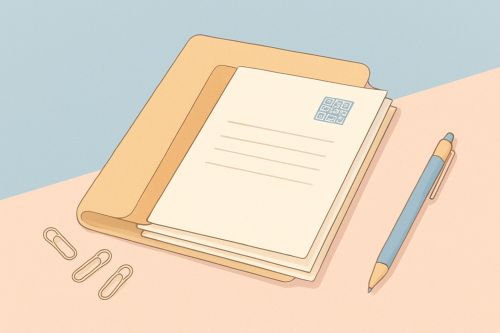
The "parent information" folder lands on the teacher's desk during the first week of September. One more sheet among the field trip permission slips, the allergy forms, the welcome notes. In the middle, a QR code printed on half an A5 page. One scan, and the teacher knows why this child loses focus by the third instruction, without needing to find out the hard way.
This situation concerns students from second to fifth grade (CE1 to CM2, in France) with ADHD known to the family, in a class that doesn't yet have an AESH (a teaching assistant for students with disabilities, in France) or a formalized PAP (personalized support plan, in France).
The moment as it happened
Second day of school, a short dictation to gauge back to school habits. The teacher reads slowly, sentence by sentence. Six students have finished, ten are keeping up, one has lost track. He looks at the radiator, taps the table, picks his pen back up partway through the next word, and misses two sentences. The teacher makes a note.
At recess, while looking for the medical information form in the parent folder, she sees the QR code on the cover. She scans it. Three paragraphs. She learns that Theo has combined type ADHD, that he can follow one long instruction but not three short ones in a row, and that his parents have set up a visual signal to help bring him back on track. No medical judgment to make. Just some footholds.
The next day, she breaks her dictation into smaller units. Theo doesn't miss a thing.
- You write it
- The QR is in place
- The reader scans
- Understood, without explaining again
Where to place the QR code for this situation
The parent folder works well because it gets opened several times during the first weeks of school: permission slips, back to school notes, forms to return. The QR code printed on the first inside page will be seen at least twice before October.
Add a second one in the school planner, on the inside cover, as a 3 cm sticker: middle school teachers will scan it when handing out the first notes. For primary school, a sticker on the home school diary is just as reliable, the teacher opens it every day.
Avoid laminated cards handed over in person at the end of class: they end up in a desk drawer and no one reopens them. Avoid long sheets that look like administrative forms, they get filed away without being read.
The logic is simple: the QR code needs to be where the teacher opens something out of obligation, not somewhere that asks them for an extra step.
Pre-written text templates
What primary school teachers remember best: one instruction at a time, a signal, a duration. The three templates below are written for a child in the middle years of primary school, to adjust based on name, age, and family situation.
For the "Introduction" section
"Theo is 9 years old, in fourth grade (CM1). He has combined type ADHD, identified at age 7. He remembers things very well when they're spoken aloud, he's quick witted, he likes projects that keep him moving. What's hard: keeping his attention on things that don't interest him right away, following three instructions in a row, staying seated when he's frustrated."
For the "How to help" section
"You can: break a long instruction into three steps written on the board, use a discreet visual signal (a hand placed on his notebook) to bring him back without calling him out by name, allow a stress ball in his left hand, plan a legitimate reason to get up every thirty minutes (fetching chalk, a book)."
For the "What to avoid" section
"To avoid: public reprimands that embarrass him without helping him refocus, collective punishments when he's the only one involved, losing recess (moving around helps him work afterward), interpreting a forgotten notebook as bad will, he takes medication in the evening."
Conditions related to this situation
This situation is based on combined type ADHD. It also applies to inattentive type ADHD (wandering attention without physical restlessness), with a few adjustments: the QR code stays useful, so do the placements, only the advice changes (favor visual reminders over tactile signals).
Similar situations
Three other situations where the QR code replaces the handwritten note in the back to school file, with reading time cut by a factor of ten.
The teacher understands why handwriting slows down without mistaking fatigue for lack of effort, and adapts written work from the first week…
View the case Student with sensory sensitivity, age 8 Reader: TeacherThe teacher identifies the triggers (playground noise, fluorescent lights) and allows a calm corner without the student having to ask out lo…
View the case Middle school student with dyslexia, age 12 Reader: Teacher for each subjectEach subject teacher reads the accommodations (font, extra time, oral format) without the student having to request them at the start of eve…
View the casePrepare your profile for this situation, without having to explain it again every school year.
You write down the essentials once. The grading teacher, the AESH (a teaching assistant for students with disabilities, in France), the substitute scan and understand. You stop repeating yourself.