






Give the lead teacher what they need to understand your social reactions, without having to justify yourself in class
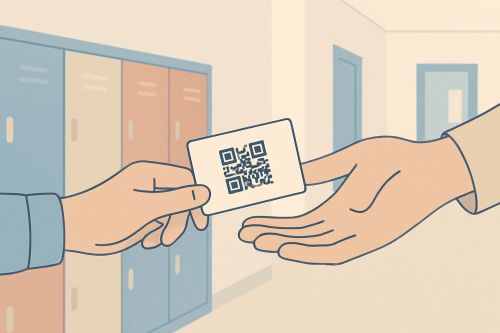
A discreet card handed to the lead teacher, the QR code leads to a clear profile. They read it in a few seconds, understand why you sometimes react differently in conversations, and can pass on the essentials to the teaching team, without you having to explain yourself in front of the others.
This case involves a 16-year-old with Asperger's syndrome. In high school, some social situations, group work, unspoken instructions, schedule changes, can be misread by adults who don't know him yet.
What actually happened
Thursday, two hours of group work in history. The teacher splits the class into tables of four. You'd rather work on your own, you say so a little too bluntly, and a classmate takes it badly. The tone rises. From the outside, it looks like arrogance or a refusal to cooperate, when in fact it's mostly the imposed format, noisy and unclear, that puts you in difficulty.
The lead teacher, walking between the tables, received a card from you at the start of the year. He takes it out and scans the QR code. A profile appears, plain: Asperger's syndrome, sometimes direct communication, a need for explicit instructions, fatigue in noisy environments, and what really helps, announcing changes in advance, allowing a defined role within the group, not reading frankness as a provocation. He offers to give you a specific part of the work, and rephrases the instructions into clear steps.
There was no comment about your "bad attitude" in front of the class, no incident report, no summons over a conflict that no one would have been able to explain. The way you work was read for what it is, not as ill will. And the useful information reached the other teachers, without you having to make the case again in every lesson.
- You write it
- The QR is in place
- The reader scans
- Understood, without explaining again
Where to place the QR code in this case
In high school, several adults are involved around you: lead teacher, subject teachers, the student affairs office. The information needs to be able to pass from one to another without you having to repeat it to each of them, and to stay under your control.
- Card handed discreetly to the lead teacher at the start of the year, printed on an A4 sheet of labels (standard template) then laminated.
- Wallet-sized card kept on you, to show yourself to a teacher during a one-on-one conversation.
- Label stuck in your planner, on the same A4 sheet of labels, so you can find it when needed.
- Link sent by message to the lead teacher, who can pass it on to the teaching team through the school's digital workspace.
The rule here: you stay in control of how it's shared. The QR code exposes nothing day to day, it gives access to the essentials only to the adult you choose to hand the card to.
Pre-written text templates
Three drafts to reuse and adapt. They cover the sections a teacher opens first when they scan: who you are, how to help you concretely, and what doesn't work. Adjust them to your situation, don't copy them as they are.
For the "Introduction" section
"My name is [first name], I'm 16. I have Asperger's syndrome: I understand and work well, but unspoken social codes take effort, and I can come across as blunt without meaning to hurt anyone. Noise and unexpected changes tire me quickly. It's not coldness, it's the way I work."
For the "How to help" section
"You can: give me explicit rather than implicit instructions, tell me in advance about changes to the schedule or organization, give me a specific role in group work, and not read my frankness as a provocation. A written note often lands better than an instruction shouted out loud over noise."
For the "What to avoid" section
"To avoid: criticizing my tone in front of the class, putting me at the center of an improvised oral exercise without warning, piling on spoken instructions in a noisy environment, or reading my need for quiet as contempt. Forcing me to "do like everyone else" in conversations solves nothing and only adds fatigue."
Conditions covered by this case
This case starts from Asperger's syndrome, a form of autism without intellectual disability or language delay. The difficulties center on unspoken social codes and sensitivity to the environment. When this way of working comes with marked sensory fatigue, the accommodations overlap: making the implicit explicit, giving notice of changes, preserving quiet time.
Similar cases
Three other situations that share the same mechanism: social behavior that's easy to misread becomes clear as soon as an adult at the school scans, at the right moment, and the useful information circulates without you having to repeat it.
The tutor understands the organisation difficulties and can suggest concrete accommodations for exams.
View the case Adult with ADHD, age 34 Reader: New colleague, managerThe person chooses when and to whom they explain how they work, in their own words, without having their lapses misread.
View the case Adult with social anxiety, age 28 Reader: HR, direct managerThe accommodations are understood without the person having to justify every request over and over.
View the caseThis situation is something you should not have to replay with every new person.
Every new school year, every new substitute, every appointment: you have to start all over again. myHandiQR puts an end to that. You write it once. You will no longer start from scratch at every meeting.