






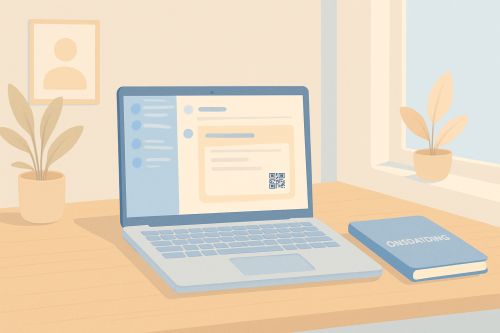
Send a message before the first day, so the team addresses you in writing from the start
A message sent on the welcome channel before the first day, and the team knows right away that writing works better than stopping someone in the hallway. No one needs to guess why spontaneous coffee breaks are avoided, the preference is set before the first handshake.
This case concerns a 30-year-old autistic adult joining a new company. He wants his future colleagues to have a written reference before he arrives, rather than discovering over the following weeks why eye contact or unexpected requests are hard for him to handle.
The moment that matters
Monday, 9 a.m., lobby of a design agency in Nantes. Yanis, 30 years old, walks through the door for his first day. In the open space, about ten faces he does not know, a coffee machine already running, someone calling out: "welcome, come meet everyone". For a colleague discovering Yanis's autism on the spot, the temptation is to multiply informal introductions, one handshake after another, without giving him time to get his bearings.
Except that three days earlier, the team lead had shared on the welcome channel for new arrivals a message Yanis had prepared himself, with the link to his profile. Two colleagues open it before the welcome coffee. They read the essentials there: Yanis is autistic, he prefers written messages to unplanned verbal requests, and a long round of introductions early in the morning exhausts him more than it helps. Nothing more, just enough to adjust the welcome.
The morning goes differently: introductions happen in small groups of two, spaced out, and the first message Yanis receives from his new team arrives in writing, with a simple "let me know if you would rather we write to you than come find you". What did not happen: the impromptu round of introductions in front of fifteen people, the silence misread as disinterest, and the obligation to explain, within the first hour, a way of functioning he had not yet had time to present in his own way.
- You write it
- The QR is in place
- The reader scans
- Understood, without explaining again
Where to place the QR for this case
Here, the QR goes to the people who will actually work with Yanis, not to the whole company. The right moment is before the first meeting, so each person can adjust their approach without needing to ask the question in public.
- Message on the welcome channel for new arrivals, sent by the manager before the first day, so the team can read it at their own pace.
- Wallet-sized card kept on hand, to show during a one-on-one conversation with a close colleague.
- Label on the laptop or notebook, printed from an A4 sheet of labels (standard template), as a discreet reminder in meetings.
- Link in the email signature, available to any external contact without having to ask.
The rule here: the information goes to the people who share the daily work, before contact, not after a misunderstanding has already happened.
Pre-written text templates
Three templates to adjust to your situation. They open with what a colleague reads first: what autism changes at work, what genuinely helps, and what makes the welcome harder. Starting points, not sentences to copy word for word.
For the "Introduction" section
"My name is [first name], I am joining the team as [role]. I am autistic: I communicate better in writing than in unplanned spoken exchanges, and I need a bit of time to find my bearings in a new environment. This is not distance, it is how I function."
For the "How to help" section
"You can: favor a written message over a surprise request, introduce me to the team in small groups rather than all at once, announce a schedule or room change in advance, let me finish a sentence before moving on, and follow up in writing if something stays unclear after a meeting."
For the "What to avoid" section
"To avoid: multiplying informal introductions continuously, forcing eye contact during a conversation, reading a silence as disinterest, commenting on how I function in front of the rest of the team, or improvising a brainstorm without announcing the topic in advance."
Conditions concerned by this case
This case relates to autism, a way of functioning that affects social communication and sensory processing, with an intensity and shape specific to each person. At work, it often shows up as a strong preference for writing and a need for predictability. The linked page details what autism covers and the adjustments that support professional integration.
Similar cases
Other workplace arrivals where a message sent at the right time, before the first contact, spares the person from having to re-explain how they function to every new face met in the hallways.
The teacher understands the atypical social behaviours and can pass the useful information on to the teaching team.
View the case High-school student with ADHD, age 17 Reader: Tutor teacher, school liaisonThe tutor understands the organisation difficulties and can suggest concrete accommodations for exams.
View the case Adult with ADHD, age 34 Reader: New colleague, managerThe person chooses when and to whom they explain how they work, in their own words, without having their lapses misread.
View the caseThis situation is something you should not have to replay with every new person.
Every new school year, every new substitute, every appointment: you have to start all over again. myHandiQR puts an end to that. You write it once. You will no longer start from scratch at every meeting.