






Handing the disability officer, right at onboarding, the list of supports that save you time, with no extra meeting
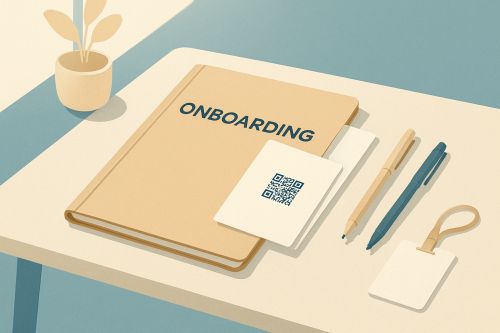
An onboarding file that the disability officer opens even before the first day, and a QR code that spells out the concrete supports: a second screen, a tidy workspace, written instructions. The accommodations are ready on arrival, with no dedicated meeting and no explanations repeated from desk to desk.
This case involves a 26-year-old adult with dyspraxia starting a new job. She wants HR and the disability officer to have the right setup straight away, rather than discovering over the weeks why certain manual or organizational tasks cost her effort.
The moment that matters
An onboarding file always comes with its share of boxes to tick and forms to fill in quickly. For Ines, 26, who has dyspraxia, it is precisely those motions that resist: writing by hand under a colleague's gaze, setting up a still-empty workspace, finding the right document in a pile. Nothing insurmountable, but an invisible drain on energy, and the risk that her slowness on certain tasks gets taken for carelessness.
Instead of waiting, she slips a card with her QR code into the file she hands to HR. The disability officer opens it before her start date. In a few lines, she reads what Ines noted herself: dyspraxia gets in the way of planning and the precision of movements, not reasoning, and a few simple adjustments change everything. A second screen so she does not have to juggle windows, written instructions, stable and clearly marked storage, time on manual tasks. The equipment is ordered before she arrives.
On the first day, the workstation is already set up. No one asks Ines to justify her second screen or to explain, to every curious colleague, why she prefers the computer to the whiteboard. The work begins on what she can do, not on what would slow her down if nothing had been planned. Information set down once, to the right person, and a whole series of small daily battles simply does not take place.
- You write it
- The QR is in place
- The reader scans
- Understood, without explaining again
Where to place the QR code for this case
At work, the QR code does not need to be on display. It goes with the onboarding documents and stays within reach of the people who decide on resources, so they can act at the right moment, preferably before the start date.
- Card slipped into the HR onboarding file, handed over at signing or during the welcome visit, to plan equipment ahead.
- Link in a direct message to the disability officer, shared as soon as the job is confirmed, before the first day.
- Label on the computer or work folder, printed from an A4 label sheet (standard template), as a discreet reminder for close colleagues.
- Link in the signature of the internal email, which each recipient can open at their own pace, with no steps to take.
The rule here: acting early beats explaining late. A workstation set up before arrival saves the person from having to ask, motion after motion, for what they need to work.
Pre-written text templates
Three outlines to adjust to your situation. They cover what an HR team or a disability officer reads first: what dyspraxia is at work, what genuinely helps, and what makes things needlessly harder. Starting points, not sentences to copy as they are.
For the "About me" section
"My name is [first name], I am joining the team as a [role]. I have dyspraxia: planning and the precision of movements take more effort for me, while reasoning and ideas are not affected. With a few simple supports at my workstation, I am fully up and running."
For the "How to help" section
"You can: provide a second screen and input tools, give me instructions in writing rather than out loud only, leave storage stable and clearly marked, allow a little extra time on manual tasks, and judge the result on substance rather than form."
For the "What to avoid" section
"To avoid: asking me to take handwritten notes under pressure, moving my equipment without warning, reading my slowness on a task as a lack of rigor, giving several spoken instructions all at once, or commenting on the way I organize myself in front of others."
Conditions involved in this case
This case rests on dyspraxia, also known as developmental coordination disorder. It gets in the way of the precise sequencing of movements and of planning, without affecting intelligence or skills. At a company, it is easily mistaken for clumsiness or a lack of effort. The linked page explains what is going on and the accommodations that restore the balance.
Similar cases
Other situations where preparing the ground before arrival, rather than explaining after the fact, spares the person a long series of justifications day to day.
The teacher understands the atypical social behaviours and can pass the useful information on to the teaching team.
View the case High-school student with ADHD, age 17 Reader: Tutor teacher, school liaisonThe tutor understands the organisation difficulties and can suggest concrete accommodations for exams.
View the case Adult with ADHD, age 34 Reader: New colleague, managerThe person chooses when and to whom they explain how they work, in their own words, without having their lapses misread.
View the caseThis situation is something you should not have to replay with every new person.
Every new school year, every new substitute, every appointment: you have to start all over again. myHandiQR puts an end to that. You write it once. You will no longer start from scratch at every meeting.