






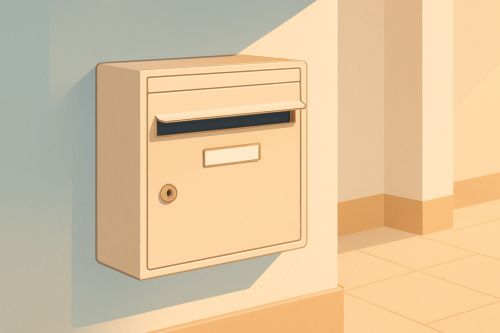
Before calling emergency services over silence behind a door, the neighbour on the landing first reads a label in the mailbox
Sofiane lives alone, door 12, third floor. The evening his music has been looping for three hours without him answering the doorbell, the neighbour scans the label stuck inside the mailbox before dialling emergency services.
Many autistic adults living in shared housing share little of their particularity with their neighbours, out of caution or from being tired of having to explain it. A discreet card, checked only in case of doubt, changes what the neighbour does in the first ten minutes.
The moment, as it happened
Karim has lived across the hall for six years. This Thursday evening in March, he notices the hallway light has been on since morning, unusual for Sofiane. Around 9pm, the same song keeps playing on loop behind the door, the volume rising now and then. Karim knocks twice, no answer, and hesitates between knocking again and calling the fire department.
He then remembers a label he once saw in the hallway mailboxes. He goes down, finds it under Sofiane's name: a text explains that looping music and silence behind the door don't always signal an emergency, that knocking hard or insisting sometimes makes things worse, and that a note slipped under the door works better than repeated knocking.
Karim writes a line on a sticky note, slips it under the door, then heads back upstairs. Twenty minutes later, Sofiane comes out to take out the trash, calm. No fire department called for nothing, no awkward apology the next day in the elevator.
- You write it
- The QR is in place
- The reader scans
- Understood, without explaining again
Where to place the QR code for this case
An adult living alone does not want to display their particularity on their front door, visible to any passing visitor. The location must stay discreet, reserved for whoever is genuinely looking for an explanation.
- Label stuck inside the mailbox flap, on a standard A4 sheet of labels, visible only when lifting the flap.
- Card slipped into a keyring hanging near the door, on the inside, for use by a relative who keeps a spare set of keys.
- Label stuck on the back of the hallway intercom panel, reserved for neighbours who already know where to look.
- Link shared once in writing with a trusted neighbour, without any physical medium, when proximity allows it.
The QR code does not replace the doorbell. It gives the neighbour what they need to choose the right reaction before knocking a third time.
Ready-to-use text templates
The following templates are a starting point. Sofiane, or a relative, adapts them to what he actually wants to share with a neighbour, never to what a standard template imposes.
For the "About me" section
"I have lived alone for six years, I am autistic. I sometimes need several hours without noise or demands, and I then listen to the same music on a loop. It is not a distress signal, it is my way of regulating myself."
For the "How to help" section
"You can: slip a written note under the door rather than ringing several times, wait until the next day if nothing else changes, text me at [phone number] if the doubt persists, alert the caretaker rather than emergency services as a first reflex."
For the "What to avoid" section
"To avoid: ringing repeatedly or insisting at the door, questioning strangers to "check", calling emergency services after just one silent evening, or touching my shoulder without warning if you pass me in the hallway."
Conditions related to this case
Autism is the central particularity here: a need for sensory withdrawal, reassuring repetition, silence that does not indicate an emergency. When anxiety is added to this, the neighbour's vigilance is better kept discreet rather than insistent.
Similar cases
Other cases where the QR code ends up with an adult living alone, between the front door and the neighbourhood, without ever replacing a real conversation.
The other person understands the situation right away and adapts how they communicate, without the person having to explain what they can no…
View the case Older adult with Alzheimer's, 78 years old Reader: Passerby, policeIn case of wandering or disorientation, someone can access the emergency information and the family's contacts.
View the case Adult with a cognitive disability, 22 years old Reader: Anyone they turn to when they're stuckThe person can get help without having to explain out loud what they cannot put into words.
View the caseThis situation is something you should not have to replay with every new person.
Every new school year, every new substitute, every appointment: you have to start all over again. myHandiQR puts an end to that. You write it once. You will no longer start from scratch at every meeting.