

What is myHandiQR?
What it ismyHandiQR, in brief
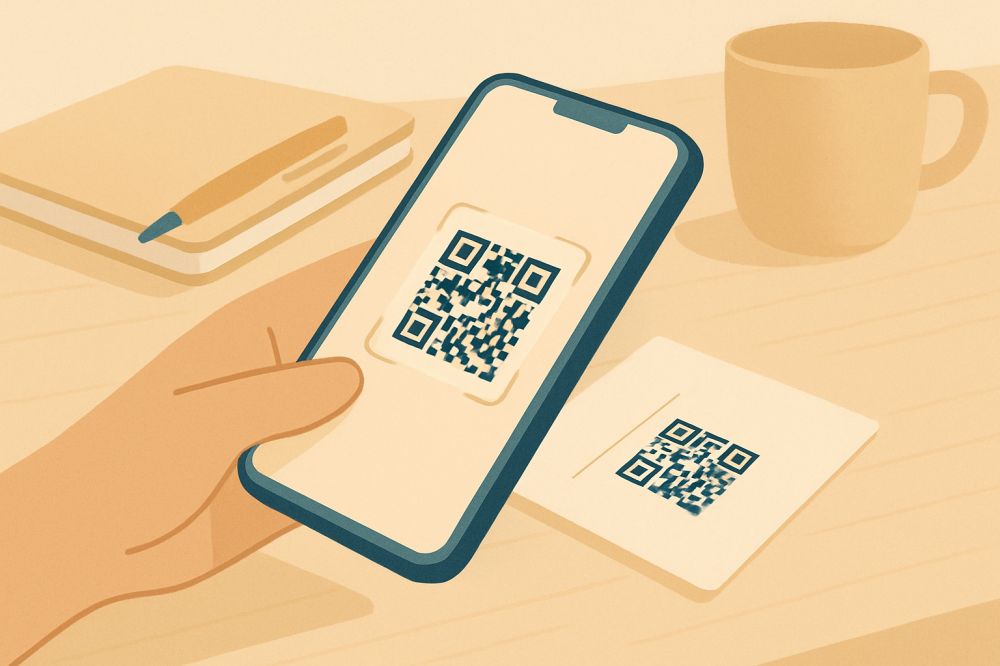
myHandiQR is a French inclusive app that lets a person affected by a disability, or those around them, get that disability understood without having to explain it again at every new encounter.
The profile creator writes three short texts (introduction, how to help, what to avoid) and ticks the disabilities involved from a list. They then share a single QR code. Everyone who scans it reaches the same profile, and explanations of each disability matched to whoever is reading: a child, a teacher, a healthcare worker or a relative do not get the same explanation of the same disability. The creator's own profile stays the same for everyone.
Where the project comes fromWhat led to myHandiQR
myHandiQR was designed by Jérôme Salanhac, an IT professional and father of two neuroatypical children (autism, ADHD, severe dyslexia). At every new school year, with every new professional, with every new adult entering their daily life, everything had to be repeated every time: finding the right words, adapting to the audience, hoping to be understood. That load, invisible but constant, is where the project started.
This experience is far from isolated. It is shared by every family affected by an invisible disability, and by adults with a disability themselves in professional or social settings. On the other side, teachers, AESH (teaching assistants for students with disabilities, in France), activity leaders and first contact care professionals live the same asymmetry: they do not have time to take in a full file, but they need to understand quickly in order to act well.
myHandiQR was created to make that first moment of contact manageable, without medical jargon, without having to go over everything again. The tool was designed and developed end to end in France, with one constant concern: that the person with the disability, or their family, keeps control over what is said about them.
Who it is forTwo complementary audiences
Profile creators: parents of children with an invisible disability (autism, ADHD, dyslexia, dyspraxia, developmental language disorder, autism spectrum conditions, long-term illnesses, epilepsy, selective mutism, hypersensitivity and more), adults with a disability at work or in social settings, family carers, guardians and deputies.
People who scan the QR code: teachers, AESH (teaching assistants for pupils with disabilities, in France), school support staff, day centre activity leaders, front-line healthcare workers, first responders, colleagues, neighbours, relatives, everyone who crosses paths with the person day to day and benefits from an explanation matched to their role.
myHandiQR can also be rolled out across an organisation (school, association, HR department, disability unit, MDPH, the French departmental disability office, medico-social organisation). See the page For organisations.
How it worksFour steps
- Three texts, adjustable at any time. The creator freely writes an introduction, a "how to help" and a "what to avoid". These three texts can be changed at any time.
- Selecting the disabilities. The creator ticks the disabilities involved from a list (autism, ADHD, dyslexia, epilepsy, hypersensitivity, and so on).
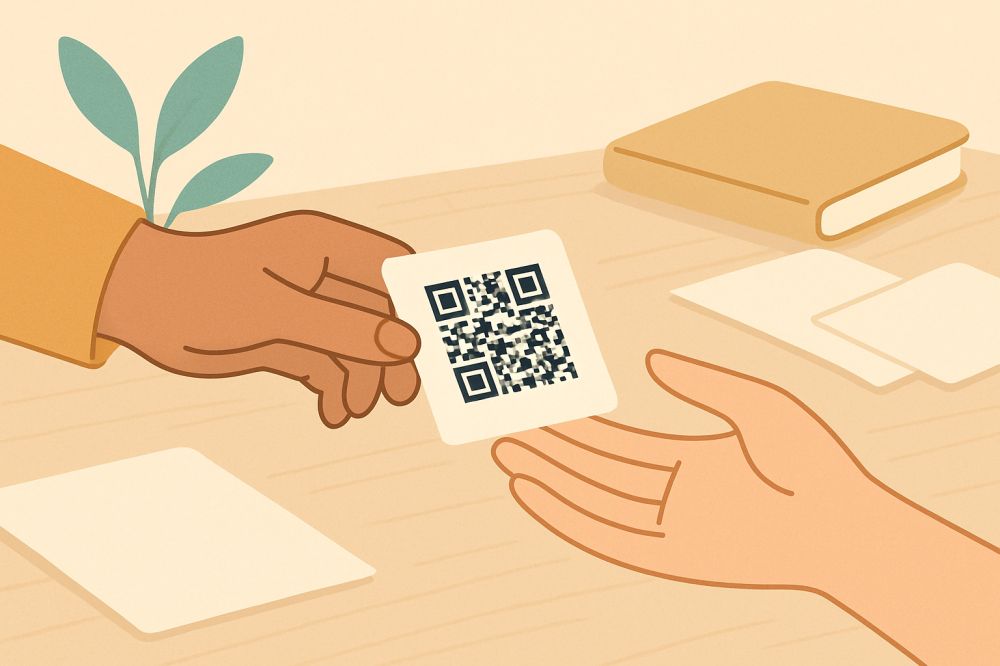
- Sharing the QR code. The QR code can be printed on a sticker, a card or a badge, slipped into a home-school notebook or a wallet, put up in a classroom or a rest room.
- Reading by the person scanning. Whoever scans it reads the creator's profile, identical for everyone. By clicking on a disability, they get a definition matched to their age and to their relationship with the person. Everything is available as audio.
Three concrete examplesHow myHandiQR is used day to day

Three real situations illustrate the typical use of myHandiQR.
- At school. The QR code is stuck into the home-school notebook of a child with dyspraxia. The teacher scans it and reads, in 30 seconds, the introduction, the "how to help" and the "what to avoid" written by the parents. She clicks on "dyspraxia" and gets a teaching definition matched to her role. When the substitute AESH arrives a fortnight later, she goes through the same steps on her own, with no file to ask for.
- At work. An adult with ADHD, employed in a small company, shares his QR code with a new colleague who has to work with him on a project. The colleague reads the profile, clicks on "ADHD" and gets a professional, factual version, with no pathos. The person concerned did not have to open up in a team meeting or prepare a speech to announce anything.
- At a day centre. A child with ADHD takes part in a sports course during the school holidays. The activity leader, who does not know the child, scans the QR code printed on his bag. He reads what helps ("give him quiet time after lunch") and what to avoid ("do not press him when he refuses an instruction, come back in five minutes"). He clicks on "ADHD" and gets a short version suited to a leisure setting.
These three examples do not exhaust the uses. myHandiQR also comes into play for occasional childcare at the grandparents', in shared custody with two households using the same profile, on family trips, in regular sports or arts activities, and to brief an education team at the start of the year.
myHandiQR is not a medical emergency device and does not stand in for any emergency service (15, 18, 112, 114 in France). It is for educational and social use, not life-critical use.
What sets myHandiQR apartFour design principles
- No medical logic. What appears is the creator's own words, not a protocol. myHandiQR is neither a medical device nor an emergency service.
- The same profile for everyone, explanations matched to each reader. The profile written by the creator stays exactly the same whoever scans it. Only the definition of the disability, opened on a click, varies with the reader's profile.
- The creator stays in control. The three texts can be changed at any time, without losing the QR code already handed out. The profile is kept even if the subscription lapses.
- A complement to the conversation, not a substitute. myHandiQR sets out the basic context so that the conversation can start straight from what matters, here, for this person.
Where myHandiQR sits among other QR services. The closest neighbours are the medical emergency QR services (RescueCode, QR-Care, MedicAlert, ICE-QR). Those services are aimed solely at emergency responders and at minimal use in a critical situation. myHandiQR does not position itself on medical emergencies but on everyday communication around disability: school, work, social life, extended family. The two territories do not overlap, and both kinds of tool can perfectly well coexist for the same person.
Pricing3 months free, then 24 €/year
myHandiQR comes with a simple model: 3 months free, no bank card, then 2 €/month per profile, that is 24 € billed once a year. No commitment, cancel at any time. The profile is kept even if the subscription lapses.
There are referrer codes that let self-employed professionals (speech and language therapists, occupational therapists, psychologists, educational specialists, ABA analysts) offer 9 free months to several of the families they work with.
No data is sold on or passed to commercial third parties. European hosting, encryption in transit (HTTPS). See the privacy policy.
ReachHow myHandiQR gets known
myHandiQR spreads through three main channels.
- Word of mouth among self-employed professionals who work with the families concerned: speech and language therapists, occupational therapists, psychologists, educational specialists, behaviour analysts (ABA), psychomotor therapists. Each professional can receive a referrer code that opens up 9 free months to several of the families they work with. The professional has nothing to manage beyond passing the code on.
- Family and user associations, notably FFDys, TDAH France, AAD France, Coridys, the Autisme France association, and the many local parent associations. myHandiQR is presented there as a complement to existing arrangements (PPS, PAP, PAI, RQTH, the French support and recognition schemes), not as a substitute.
- Specialist blogs and media covering neurodiversity, parenting a child with additional needs, and invisible disability at work. The myHandiQR blog regularly publishes articles on these subjects: preparing for the new school year, briefing a substitute, managing shared custody, obtaining an RQTH (French recognition of disabled worker status) without laying yourself bare.
The one-year aim is to build a base of families using the tool day to day, particularly at school and in after-school activities, and to build a network of self-employed professionals who pass it on naturally to the people they work with.
Who publishes myHandiQRA French SASU
myHandiQR is published by SASU myHandiQR, a French company registered with the Paris trade register (SIREN 104 999 701), founded in 2026 by Jérôme Salanhac.
An independent publisher. The project is run autonomously, with no fundraising and no outside investor. The aim is neither a sale to a group nor a stock market listing, but the long-term survival of a service that is useful to as many affected families as possible. Growth is organic, funded entirely by customer subscriptions. This independence is a governance choice: it guarantees that product decisions stay aligned with the interests of the people concerned and those close to them, with no short-term pressure on profitability.
Technology. myHandiQR is a responsive web app, designed mobile-first (the QR code is mostly scanned with a phone). QR code generation, hosting of the public profiles, an explanation-rewriting engine based on a large language model (LLM), audio playback via speech synthesis. European hosting (OVHcloud, Roubaix), encryption in transit (HTTPS).
Contact: contact page. See also the legal notice and the privacy policy.