






Help every adult at school understand that your child drifts off through inattention, not lack of interest
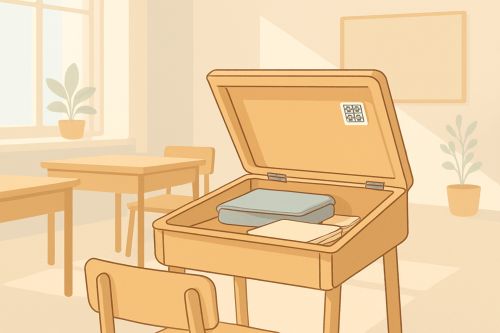
A discreet label stuck inside your child's desk, the QR leads to a clear sheet. The teacher or activity leader reads it in a few seconds, understands that his moments of absence are not indifference, and adapts the way they catch his attention without telling him off in front of the class.
This case involves an 8-year-old child with an attention difficulty without hyperactivity. In class, he drifts off in silence, without disturbing anyone, which makes his difficulties easy to confuse with daydreaming or bad will.
The moment as it happens
Tuesday morning, during dictation. The teacher repeats the sentence, the class writes, and your son stares at a spot near the window. He did not hear the instruction, not out of refusal, but because his attention slipped elsewhere without him noticing. When he comes back to his page, the others are already three lines ahead. Seen from the outside, it looks like deliberate distraction or a lack of effort.
A substitute is taking the class this week. Looking for a pencil, she opens the student's desk and comes across a small label with a QR code. She scans it. A sheet appears, plain: attention difficulty without hyperactivity, silent drifting off, slow to get going again, and what really helps, warning him before calling on him, splitting up instructions, checking that he has actually started. At the next exercise, she steps closer, catches his eye, and gives the instruction again in one short sentence.
There was no "you never listen" thrown out in front of the others, no mark in the notebook, no comparison with the child at the next desk. The drifting off was read for what it is, a difficulty in holding attention, and not as a tantrum. Your child was able to follow the exercise without carrying, on top of it, the weight of a reproach.
- You write it
- The QR is in place
- The reader scans
- Understood, without explaining again
Where to place the QR for this case
In primary school, several adults take turns around the child: teacher, substitute, after-school activity leader. The information has to stay close to him, where it will be seen at the moment attention drifts.
A few placements that work well in this context:
- Label stuck inside the student's desk, printed on an A4 label sheet (standard model).
- Laminated card given to the teacher and the after-school team at the start of the year.
- Label slipped into the planner or the pencil case, on the same A4 label sheet.
- Link added by the parent in the digital home-school notebook, accessible to the adults at the school.
The rule here: the QR is not a label placed on the child, it is a key to understanding given to the adult who has to help him stay engaged.
Pre-written text templates
Three outlines to take and adapt. They cover the sections adults open first when they scan: who the child is, how to help concretely, and what does not work. Adjust them together, without copying them as they are.
For the "Introduction" section
"My name is [first name], I am 8. I have an attention difficulty without hyperactivity: I often drift off without realising, especially when it is long or noisy. It is not that I am bored or that I do not want to, my attention wanders off on its own and I struggle to bring it back."
For the "How to help" section
"You can: catch my eye before giving me an instruction, break it into short steps, check that I have really started, and gently warn me when you see that I have drifted off rather than telling me off."
For the "What to avoid" section
"What to avoid: blaming me in front of the class for not listening, stringing together several instructions at once, reading my forgetfulness as laziness, or rushing me when I take time to get back to work."
Conditions involved in this case
This case starts from the attention difficulty without hyperactivity, the most discreet form and the easiest to overlook. The child does not disturb anyone, he drifts away. When this form comes with organisation difficulties or slowness, the helpful adaptations come together: framing attention, easing the load, securing the start of tasks.
Similar cases
Three other situations that share the same mechanism: a behaviour easy to confuse with bad will becomes clear as soon as an adult at the school scans, at the right moment.
The teacher understands, right when marking, why the handwriting is difficult, without the child having to ask out loud for leniency.
View the case Autistic child (ASD level 1), age 7 Reader: Substitute teacherThe substitute can access the sensory triggers and routines without any written handover, and without singling the child out in front of the…
View the case Child with ADHD, age 11 Reader: AESHThe support assistant has the right strategies from day one, with no trial and error and no extra meeting.
View the caseNo need to explain it to every new person.
Three texts (introduction, how to help, what to avoid), one shared QR code. When they scan it, the person reads what they need to know, in their own language.