






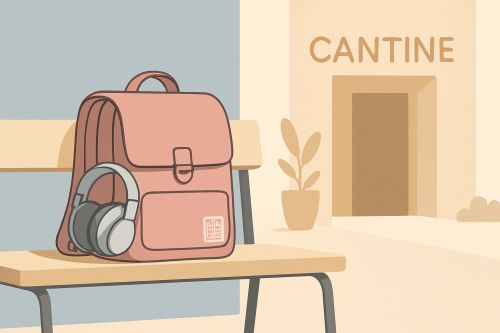
Child with sensory sensitivity at the school canteen, age 7
A school cafeteria means 90 children under fluorescent lights, a tray, three rows of tables, noise climbing to 85 decibels. A child with sensory hypersensitivity hits the saturation point by 12:10. He cries, eats little, and goes back to class at 1:30 pm with his nervous system drained. A form at the cafeteria's front desk, scanned by the supervisor on duty: a quiet table, noise-cancelling headphones allowed, a lunch he can get through.
This case applies to children with sensory hypersensitivity (with or without autism spectrum disorder) enrolled in a municipal after-school program, often with a staff who never meets the parents.
The moment as it happened
The school cafeteria, 12:05 pm, Thursday. Children come in waves of 20. The supervisor, Latifa, watches the line. She sees a second-grader, Adam, pressed against the wall, hands over his ears, lips pinched tight. She goes over. She notices a round QR sticker on the backpack next to him. She takes out her phone.
She learns that Adam has had sensory hypersensitivity for as long as anyone can remember (confirmed by speech therapy and occupational therapy assessments), that the cafeteria is the worst part of his day because of the noise and light, that he can wear noise-cancelling headphones that are in his backpack (left side pocket), and that he eats better at the quiet table at the back near the window if he's seated with a chosen buddy (Timeo, also in second grade).
She takes the headphones out of the backpack and puts them on Adam. She calls Timeo over and seats the two of them at the table by the window. Adam drinks from his water bottle, opens his tray, and eats slowly. At 12:45 pm, he goes back to class tired but intact.
- You write it
- The QR is in place
- The reader scans
- Understood, without explaining again
Where to place the QR code for this case
A laminated A5 sheet at the after-school program's front desk, in the coordinator's binder, next to the registration forms. A 3 cm round sticker on the child's backpack (outer pocket, visible side) for staff who don't have access to the binder.
Duplicate it in the snack box (staff often open the box to check for allergies). For Wednesday outings, the sticker goes on the backpack, not on the raincoat (which gets lost).
Avoid emailing the town hall: it doesn't reach the after-school program level. Avoid handing the form only to the coordinator at the start of the year: she isn't always on duty at the critical moment in the cafeteria.
For private school cafeterias with a stable team, a form posted in the coordinator's office (with parental consent) lets the whole team know without having to scan at every service.
Pre-written text templates
The three templates below are written from the parent's side. The wording describes the moment of overload without dramatizing it, with immediate solutions a staff member can put in place without needing special permission.
For the "Introduction" section
"Adam is 7 years old, in second grade. Severe sensory hypersensitivity (noise, light, crowds) confirmed by an occupational therapy assessment in 2024. He manages well in class but struggles at the cafeteria (85 dB on average, fluorescent lights, close quarters). He doesn't have autism spectrum disorder, he doesn't have ADHD, he has a very finely tuned sensory system that reaches saturation quickly in dense environments."
For the "How to help" section
"You can: allow the noise-cancelling headphones in his backpack (left pocket) throughout the meal, seat him at the quiet table at the back with Timeo, let him step out to the courtyard for 5 minutes if he's overwhelmed, help him open his water bottle and his tray (his hands shake at the point of overload), warn him before the bell rings at the end of service."
For the "What to avoid" section
"To avoid: forcing him to eat with the group at the big tables, taking off his headphones halfway through the meal to socialize, telling him to make an effort, asking him to eat faster, raising your voice to call him from across the room, forcing him to finish his tray (he makes up for it at home)."
Conditions related to this case
This case is built around isolated sensory hypersensitivity in an after-school cafeteria. It also applies to children with associated autism spectrum disorder, children with ADHD who become overwhelmed in dense, noisy environments, and children with Tourette syndrome (tics increase with sensory load).
Similar cases
Three other cases where the QR code lets the after-school staff offer a sensory adjustment without singling the child out in front of peers.
The youth worker includes the child in group games by anticipating risky moments (transitions, waiting times), without punishing restlessnes…
View the case Teen with social anxiety at summer camp, age 12 Reader: Summer camp director, activity leaderThe camp staff identify risky moments (large groups, noisy evening activities) and offer discreet ways to step back without stigmatizing the…
View the case Deaf child in a sports club, age 9 Reader: Sports coachThe coach adjusts instructions (visual cues, gestures, signaling exercises) so the child isn't left out from missing a spoken request.
View the casePrepare your profile for this situation, without having to explain it again every school year.
You write down the essentials once. The grading teacher, the AESH (a teaching assistant for students with disabilities, in France), the substitute scan and understand. You stop repeating yourself.