






He gets stuck on the first words, especially on the phone: the card slipped into the apprenticeship contract tells the garage owner before his first morning at the counter
A card slipped into the apprenticeship contract folder, scanned by the apprenticeship mentor on signing day, and he knows that Bastien gets stuck on certain words. He doesn't send him to answer the phones on the first morning without warning. He doesn't finish his sentences for him.
This case is about a 19-year-old apprentice training for a CAP in vehicle maintenance (a French vocational diploma), who has stuttered since childhood. He wrote the profile himself, for the garage that hosts him on a work-study basis for two years.
The moment as it happened
Monday, 8:05 am, an independent garage on the outskirts of Villefranche-sur-Saône. The smell of brake fluid, a car lift already raised, the radio on in the background. Bastien, 19, is starting his apprenticeship contract. Thierry, the owner, signed the official form last week with the CFA (the apprentice training centre). They talked for ten minutes. Bastien mostly nodded.
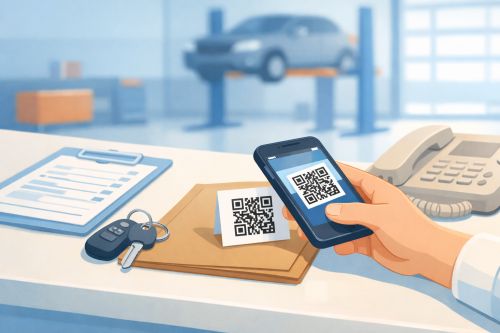
In the contract folder, there's a card with a QR code. Thierry scans it between two phone calls. Bastien wrote it himself. He stutters. The blocks mostly hit the first words and the phone, and the more he is rushed, the more he gets stuck. He understands everything. He knows his technical sheets. He just needs a few extra seconds to get a sentence out, that's all.
At 10 am, a customer comes in for an oil change. Thierry stays near the counter without speaking for him. Bastien takes out the service sheet, points to the mileage, gives the turnaround time. The word "Wednesday" takes three seconds to come. Nobody finishes it for him. The phone will come in two weeks, with a two-line script taped under the screen.
- You write it
- The QR is in place
- The reader scans
- Understood, without explaining again
Where to place the QR for this case
In an apprenticeship, the first reader is the apprenticeship mentor, but not the only one. There's the workshop manager, the colleague at the front desk, sometimes a stand-in during the August holidays. The QR has to circulate without Bastien having to explain himself again to every new face.
- Card slipped into the apprenticeship contract folder, handed over on signing day: the boss finds it while filing the training centre paperwork, with a clear head, and not in the middle of a rush.
- QR stuck on the back of the apprenticeship logbook that the mentor fills in for each period in the company: he finds it again at every review with the training centre instructor.
- Ruled out: a sign at the counter or in the workshop. Customers would see it, and Bastien would become "the apprentice who stutters" to the whole clientele.
- Ruled out: the work clothes. Overalls go to the wash every week, and it's not up to customers to scan.
The card doesn't replace the conversation. It simply avoids the first morning being spent discovering, live in front of a customer, what could have been known the day before.
Pre-written text templates
The outlines below are starting points for filling in the three sections of a myHandiQR profile. Rewrite them the way you speak. The situations where you get stuck the most, at the counter or on the phone, are what your apprenticeship mentor most needs to know.
For the "Introduction" section
"My name is [first name], I'm [age] and I've stuttered since I was little. It mostly blocks on the first word of a sentence and on the phone. I understand everything I'm told and I know my job. I just need a few more seconds to speak."
For the "How to help" section
"Let me finish, even if it takes a while. Look at me normally while I'm speaking. For the phone, let me first listen to a colleague, then pick up with a two-line script in front of me. For a complicated quote, I can write it down and show it to the customer."
For the "What to avoid" section
"Avoid finishing my sentences or giving me the word. Avoid saying "breathe" or "calm down", it doesn't come from stress. Avoid putting me on the phones without warning, especially in front of customers. Avoid joking about it in front of the team."
Conditions covered by this case
Stuttering is at the heart of this case: speech blocks increase with time pressure and being looked at. Anxiety often comes on top of it, from constantly anticipating every moment when he'll have to speak quickly. The same pointers work for an apprentice with DLD (developmental language disorder) or dysarthria.
Similar cases
These cases share the same situation: a manager meets someone at the time of hiring or starting a new job, and needs to know, without the person having to justify themselves, how to adjust what they ask.
The recruiter adjusts her questions (less unspoken meaning, no trick scenarios) and correctly interprets the lack of eye contact, without co…
View the case Employee with ADHD during onboarding, age 34 Reader: Direct managerThe manager structures interactions (short, frequent check ins, written instructions, visible priorities) so the employee's forgetfulness is…
View the case Employee with generalized anxiety, age 28 Reader: HR director, disability officerThe HR director grants some remote work and an adjustment to the open space setup, so the employee doesn't have to describe her anxiety out …
View the casePrepare your profile for this situation, without having to explain it again every school year.
You write down the essentials once. The grading teacher, the AESH (a teaching assistant for students with disabilities, in France), the substitute scan and understand. You stop repeating yourself.