






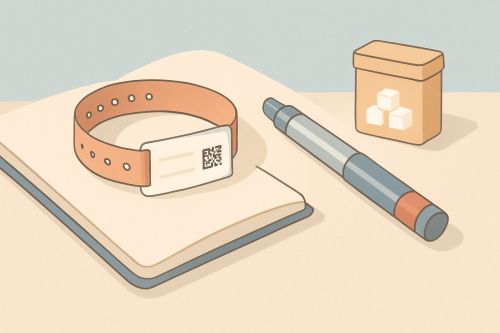
Give sugar first and call afterwards, that is what the passer-by reads when scanning the back of your phone
A QR code stuck on the back of the phone, and the person leaning over you during a severe hypoglycaemic episode reads the order of actions you wrote yourself: fast-acting sugar as long as you can swallow, nothing forced if you no longer respond, and a call to 15 (the French medical emergency number) without waiting for it to pass on its own.
This case involves an adult living with diabetes and sudden drops in blood sugar, which happen in the street, at the office or on public transport, at the precise moment when they can no longer explain what is happening to them.
In the break room, just before eleven
The words come out in the wrong order, the hand shakes on the cup, the gaze drifts to a point on the wall. In the break room, two colleagues of Yann, 38, first think it is a joke, then a bout of tiredness. One suggests walking him back to a chair, the other talks about calling someone, without knowing who. Neither of them knows about his diabetes: he has never mentioned it at work.
His phone is lying next to the cup, a sticker on the back, a few words and a QR code. A colleague scans it. She reads what Yann wrote himself: probably hypoglycaemia, fast-acting sugar straight away if he can still swallow, nothing in his mouth if he no longer responds, a call to 15 (the French medical emergency number) if nothing improves within a few minutes, and his partner's number to call afterwards. She takes the sugar cubes from the coffee tray, puts them in his hand, and stays beside him.
Yann comes back round, finds his words again, almost apologises for the incident. The emergency services were not called out for an unknown reason, and no colleague concluded that he had been drinking because his speech was slurred. The next day, he is back at his desk without having had to tell half the floor about his diabetes, or to justify to HR an episode that nobody would have been able to describe.
- You write it
- The QR is in place
- The reader scans
- Understood, without explaining again
Where to put the QR code in this case
Severe hypoglycaemia comes with no warning, often in front of people who know nothing about you. So the QR code has to be findable by someone looking fast, in the two places people instinctively check: the phone and the wallet.
- A laminated card in the wallet, next to the ID, in the exact spot a first responder looks at when searching for an identity.
- A label on the back of the phone or under the case, printed from an A4 sheet of labels (standard format), with the wording "possible hypoglycaemia, please scan".
- A card-holder wristband for running and cycling, when neither the wallet nor the phone is within reach.
- A label in the locker or on the water bottle at the office, from the same A4 sheet, for colleagues who find you before the emergency services do.
Two places are better than one: whoever helps you will look at the phone lying next to you, rarely at the bottom of a closed bag.
Ready-made text templates
The sentences below are a starting point for writing your own instructions. They are worth going through with the person who follows your care, keeping only what you are willing to make readable by a stranger.
For the "About me" section
"My name is [first name]. I live with diabetes and I have severe hypoglycaemic episodes: my blood sugar can drop suddenly, and I then become confused, slow to answer, sometimes unable to say what is wrong. It is neither a heart problem nor alcohol."
For the "How to help" section
"You can: give me fast-acting sugar if I can still swallow (sugar cubes, fruit juice, sugary soft drink), stay with me until it comes back up, put me on my side if I lose consciousness, call 15 (the French medical emergency number) if nothing changes within a few minutes, then let [first name] know on [phone number]."
For the "What to avoid" section
"Please avoid: making me drink or eat if I no longer respond, leaving me alone while you go and get help, waiting for it to pass on its own, making me walk or getting me up too quickly, or concluding that I have been drinking because my speech is slurred."
Conditions covered by this case
This case involves diabetes, when the treatment exposes the person to sudden drops in blood sugar. Seen from the outside, severe hypoglycaemia looks like drunkenness or an ordinary faint, and it is precisely that confusion that costs the first few minutes, the ones that matter most.
Similar cases
Other situations where the person concerned prepares their own profile, and decides in advance what a colleague, a relative or a first responder will be able to read on their behalf on the day they cannot say it themselves.
The teacher understands the atypical social behaviours and can pass the useful information on to the teaching team.
View the case High-school student with ADHD, age 17 Reader: Tutor teacher, school liaisonThe tutor understands the organisation difficulties and can suggest concrete accommodations for exams.
View the case Adult with ADHD, age 34 Reader: New colleague, managerThe person chooses when and to whom they explain how they work, in their own words, without having their lapses misread.
View the caseNo need to explain it to every new person.
Three texts (introduction, how to help, what to avoid), one shared QR code. When they scan it, the person reads what they need to know, in their own language.