





Bass, strobe lights, crowds: the card tucked behind the festival pass tells the first aider that Lila hasn't been drinking, and that the first thing to do is dim the lights
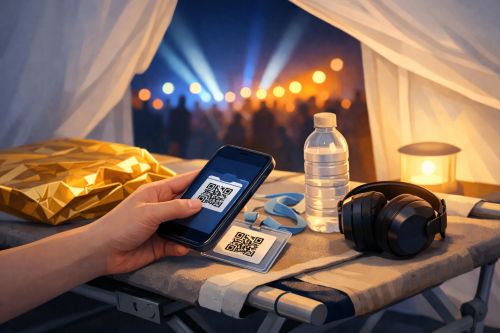
A card tucked behind the pass, in the lanyard badge holder. The volunteer first aider scans it under the first aid tent, and he knows that Lila hasn't been drinking. He switches off the strip light at the back, moves her away from the speakers, and asks his questions one at a time.
This case concerns a 19-year-old young woman who is very sensitive to sounds, lights and crowds, and for whom overload can tip over into an anxiety attack. She wrote the profile herself, for the first aid teams at the festivals she goes to every summer.
The moment as it happened
Saturday, 11:40 pm, an open-air festival in Finistère, in Brittany. The electro set on the main stage has just started, and the bass is making the barriers vibrate. Lila, 19, has got stuck in the pit between two groups who are pushing. The strobe lights. She crouches down, hands over her ears, short of breath. Her friend Amina brings her back, an arm under her shoulder, to the white first aid tent at the campsite entrance.
Karim, a volunteer first aider with an approved civil protection association, starts his assessment. She doesn't answer. She is shaking. On the form, the reflex would be to tick "alcohol?". Amina points to the badge holder. Behind the three-day pass, there is a card with a QR code. Karim scans it.
Lila wrote it herself. Noise and light quickly overwhelm her. When it gets too much, she can't speak for a while. She hasn't been drinking. What helps her: a darker corner, a single voice, no hand placed on her without warning. Karim draws the curtain of the cubicle at the back, lowers his head torch, sits down at her level. One yes or no question. He waits. She nods. Twenty minutes later, she drinks a little water and says her first name.
- You write it
- The QR is in place
- The reader scans
- Understood, without explaining again
Where to place the QR code for this case
At a festival, everything gets lost. The phone falls in the mud, the wallet stays in the tent, the bag goes to the cloakroom. The QR code has to stay on Lila, somewhere a first aider looks anyway, without having to search through her belongings.
- Card tucked into the lanyard badge holder, behind the pass: it's one of the first places the first aid post team looks to identify someone, and the friend with her knows where to find it.
- A duplicate sticker on the back of the phone case, for the evenings when the lanyard has stayed at the campsite.
- Ruled out: the festival fabric wristband. Too narrow for a readable QR code, often linked to cashless payment, and nobody should have to handle it.
- Ruled out: the wallet. Going through the pockets of a person who can't speak raises the tension, and many teams avoid doing it without a witness.
Before leaving, Lila also tells her friends that the card exists. They are often the ones who arrive at the first aid post with her, and the ones who hand it to the first aider.
Pre-written text templates
The outlines below are a starting point for filling in the three sections of a myHandiQR profile. Write them with your own reference points. A first aider reads standing up, in the noise: what helps most is understanding what is happening and knowing what to do right away.
For the "Introduction" section
"My name is [first name], I am [age]. I am very sensitive to noise, flashing lights and crowds. When it gets too much, I may shake, breathe fast and be unable to speak for a while. I haven't drunk or taken anything. I understand what people say to me."
For the "How to help" section
"Take me to a darker corner, away from the speakers. Only one person talks to me, gently. Ask me questions I can answer yes or no with a nod or a shake of the head. Tell me before you touch me or take my blood pressure. My ear defenders are in the front pocket of my bag."
For the "What to avoid" section
"Avoid shaking me or having several people talk to me at once. Avoid shining a head torch in my eyes. Avoid asking me over and over what I've taken. Avoid leaving me alone to go and get someone: I need one person to stay beside me."
Conditions covered by this case
Sensory hypersensitivity is at the heart of this case: sounds, lights and touch all become too strong at the same time. Anxiety comes on top when the overload spills over. The same approach works for an autistic person or a person with ADHD at a large gathering.
Similar cases
These cases share the same situation: an emergency responder comes across a person who can't explain themselves at that moment, and needs to know within a few seconds how to approach them without making things worse.
The other person understands the situation right away and adapts how they communicate, without the person having to explain what they can no…
View the case Older adult with Alzheimer's, 78 years old Reader: Passerby, policeIn case of wandering or disorientation, someone can access the emergency information and the family's contacts.
View the case Adult with a cognitive disability, 22 years old Reader: Anyone they turn to when they're stuckThe person can get help without having to explain out loud what they cannot put into words.
View the caseThis situation is something you should not have to replay with every new person.
Every new school year, every new substitute, every appointment: you have to start all over again. myHandiQR puts an end to that. You write it once. You will no longer start from scratch at every meeting.