


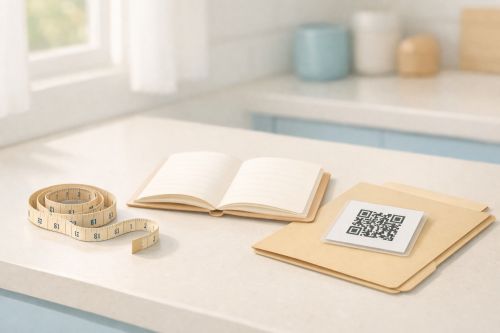
A file that comes with its own instructions: the card slipped onto the first page shows the occupational therapist how to walk into your home without surprises
A card slipped onto the first page of the housing adaptation file, read by the occupational therapist before she rings the doorbell, and the visit stops being something endured and becomes an exchange where each room is introduced at its own pace.
This case is about an autistic adult, 41, who lives alone and is preparing to adapt his home with a freelance occupational therapist. The profile is written by the person himself, for the professional who arrives with a tape measure and a notebook.
The lived moment
Tuesday, 10 a.m. Marius has tidied the entrance, turned the radio down, opened the kitchen window to let out the smell of coffee. The occupational therapist rings, twice, then a third time because she thinks he did not hear. He heard. The third ring goes straight through his skull.
She walks in talking, puts her bag on the table, pulls out a tape measure that snaps against the worktop, opens cupboards, asks how he prepares his meals, where he keeps his medication, and whether the shower is slippery. Four questions in one minute. Marius answers the first, then looks at the floor and says nothing more.
When she opened the file lying on the table, she found the card. She scanned it and read: the sound of repeated doorbells, stacked questions, the preference that the room be announced before she goes in. She put the tape measure away and started again in the living room, one question at a time. Marius himself showed her the cupboard that stops him from cooking.
- You write it
- The QR is in place
- The reader scans
- Understood, without explaining again
Where to place the QR for this case
The occupational therapist has no file on the person before she arrives, and she does not look at the door or the fridge when she walks in. She opens what she is handed. So the QR has to travel with the file meant for her.
- Card slipped under the flap of the cardboard folder holding the housing adaptation request, together with the MDPH (French disability authority) notification.
- Message sent with the appointment confirmation, with the profile link, so she can read it the day before.
- Sticker placed on the inside of the front door, at eye level, for a replacement or a colleague who comes in her place.
- Card in the holder's phone, if he is the one who opens the door.
To avoid: the mailbox, which nobody looks at when they walk in, and the doorbell itself, too small to carry a readable message.
Ready-made text templates
These outlines are a starting point for filling in the profile sections. Rewrite them in your own words: what you can bear and what you prefer is what makes the profile truly useful to the person who comes into your home.
For the "Introduction" section
"My name is Marius, I am 41 and I am autistic. I understand instructions well, but repeated noises and rapid-fire questions shut me down. I live alone and I want to adapt my home."
For the "How to help" section
"Let me know by message when you are arriving, ring only once. Tell me which room you are going to see before you go in. Ask one question at a time, give me time to answer. I show better than I describe."
For the "What to avoid" section
"Please avoid repeated ringing, the sounds of tape measures and cupboards opened all at once, stacked questions. Please avoid moving my things without telling me, they each have a precise place."
Conditions covered by this case
This case talks about autism and sensory hypersensitivity, but the same card works for anyone whose home becomes hard to share with a professional: a person with ADHD, strong anxiety, or dyspraxia that makes the space hard to describe.
Similar cases
Other professionals come into the person's home or receive them in their practice: here are similar situations, from the home care assistant to the physiotherapist.
The dentist understands the sensory sensitivities (chair noise, light, texture) and offers useful adaptations (headphones, breaks) without d…
View the case Adult with sensory sensitivity, age 45 Reader: Self-employed nurseThe nurse adjusts her presence (soft voice, announced gestures, no perfume) without having to discover the needs during a first crisis, whic…
View the case Child with FASD, age 10 Reader: PediatricianThe pediatrician knows about the fetal alcohol spectrum disorder from the outset and avoids convenience diagnoses or unsuitable referrals du…
View the caseNo need to explain it to every new person.
Three texts (introduction, how to help, what to avoid), one shared QR code. When they scan it, the person reads what they need to know, in their own language.