






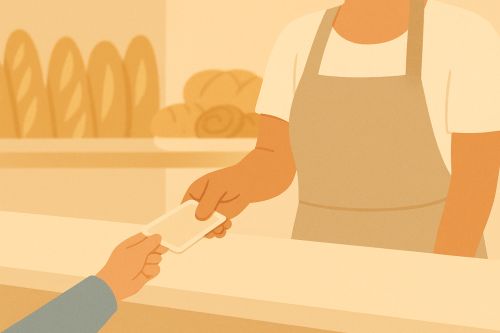
At the bakery counter, a card held out in silence lets her order without ever having to speak out loud
Lila walks into the neighborhood bakery alone for the first time, on a Saturday morning. At the counter, the shop assistant's question gets no spoken answer: Lila holds out a laminated card, and the order goes ahead without a single word being said.
Selective mutism blocks speech in certain specific settings, often in front of an adult who isn't familiar, even though the same child talks without difficulty at home. A written aid, held out at the right moment, stands in for the voice that doesn't come.
The moment, as it happened
Lila is nine years old and has always dreaded the glass door of the bakery on Rue Pasteur. This Saturday, twenty to noon, her mother hands her two coins and stays on the pavement, visible from the shop window. Lila pushes the door open, the bell rings, the smell of warm bread fills the line of three people.
Ahead of her, Céline asks: "And for you, sweetheart?" Lila looks down, grips the laminated card at the bottom of her pocket, then pulls it out and places it on the counter without looking up. The card reads: a baguette not too well done, cash payment, no bag if possible. Céline reads it, nods, rings it up without repeating her question out loud.
Lila leaves with the baguette under her arm, without having said a word, without the embarrassed look that usually follows too long a silence at the counter. Her mother, on the pavement, had nothing to explain beforehand, nothing to smooth over afterward.
- You write it
- The QR is in place
- The reader scans
- Understood, without explaining again
Where to place the QR for this case
A child who runs more and more errands alone over the year needs a support she can always find in the same place, without having to search for it in front of the shop assistant or ask for help.
- Card laminated and slipped into the front pocket of her jacket, detached from an A4 sheet of labels (standard template) in business card format.
- Label stuck inside the child's purse, visible as soon as it's opened, for days when the jacket pocket changes.
- Card clipped to a short cord worn under the sweater, taken out only at the counter, never displayed in the school playground.
- Link shared once with the regular baker by the mother, alongside the card, for days when Lila forgets to take it out.
The support isn't a label to display permanently. It's only used at the exact moment when speech doesn't come, and stays put away the rest of the time.
Pre-written text templates
The three templates below are a starting point. Lila's mother adjusts them depending on the shops she visits, removing anything that no longer matches what her daughter actually wants to share with an unfamiliar adult.
For the "About me" section
"Lila is nine years old and lives with selective mutism. She understands everything and talks without difficulty at home, but her voice doesn't come out in front of an adult she doesn't know well, especially in a shop."
For the "How to help" section
"You can: read the card she hands you without asking her to repeat it out loud, let her point at what she wants, carry on with the transaction as usual without commenting on her silence."
For the "To avoid" section
"To avoid: insisting with ‘aren't you going to say hello?’, staring at her while waiting for a spoken answer, or telling other customers in line that she ‘doesn't talk’."
Conditions covered by this case
Selective mutism is the central particularity here: speech stays blocked in certain specific settings, never a choice or a lack of manners. Social anxiety often goes along with it, without always needing to be named at the counter.
Similar cases
Other cases where the QR code supports a first outing alone, between shop and neighborhood, without ever replacing the conversation that follows.
The other person understands the situation right away and adapts how they communicate, without the person having to explain what they can no…
View the case Older adult with Alzheimer's, 78 years old Reader: Passerby, policeIn case of wandering or disorientation, someone can access the emergency information and the family's contacts.
View the case Adult with a cognitive disability, 22 years old Reader: Anyone they turn to when they're stuckThe person can get help without having to explain out loud what they cannot put into words.
View the casePrepare your profile for this situation, without having to explain it again every school year.
You write down the essentials once. The grading teacher, the AESH (a teaching assistant for students with disabilities, in France), the substitute scan and understand. You stop repeating yourself.