






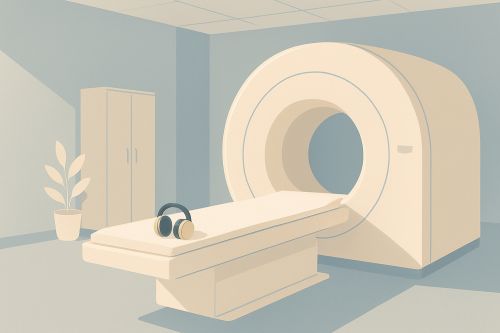
Before an MRI, a QR code slipped into the appointment folder tells the radiographer how to announce each sound, without the autistic person having to explain it themselves.
Yanis is 24, he is autistic with marked sensory hypersensitivity, and he needs an MRI of his knee after a football injury.
This case shows how a QR code slipped into the appointment folder lets the radiographer announce each sound before it happens, without any instruction ever needing to be repeated louder.
How it plays out
Yanis arrives at the imaging department at 8:20am, the appointment letter folded in quarters in his pocket, ten minutes before the changing rooms open. He has already taken off his watch and keys in the car, so he doesn't have to do it in front of someone.
In the waiting room, the dimmer light on the ceiling flickers for a second before settling, a detail no one else seems to notice. The radiographer calls him by his first name, notices the card held out before she even asks her first question, and reads it standing, near the control station.
She lowers the volume of the intercom, warns him that the table is about to vibrate before it moves, and announces the countdown for each noisy sequence instead of leaving him to guess. Yanis keeps the earplugs provided, closes his eyes during the knee scan, and the exam ends without him ever having to raise his hand to ask for a pause.
- You write it
- The QR is in place
- The reader scans
- Understood, without explaining again
Where to place the QR code for this case
An autistic adult who attends medical appointments alone keeps the card on them rather than handing it to a relative who won't be present in the exam room. For this case, three placements stand out:
- Laminated card slipped into the appointment folder, between the prescription and the insurance card, shown at reception even before being called into the room.
- Tag on the bag left in the changing room, noticeable to the radiographer coming to collect the next person.
- QR code on the phone lock screen, useful if the appointment folder is accidentally left in the car.
One placement is deliberately ruled out: sticking the QR code onto the medical file passed on by the referring doctor, because this document travels between several departments without Yanis being present to give his consent at each consultation.
The rule of thumb: the card must stay in the hands of the person concerned, shown at the moment they choose, never slipped into a file beyond their control.
Ready to use text templates
Three templates to adapt to the situation. They cover what a radiographer reads first before positioning someone on the exam table: who is speaking, how to announce a sound in advance, and what makes an imaging exam harder when it's rushed.
For the "Introduction" section
"My name is Yanis, I'm 24. I'm autistic and hypersensitive to sounds and lights. A sudden noise or unexpected vibration can make me startle badly, even if I don't show it at the time."
For the "How to help" section
"You can: tell me about each sound before it starts, warn me before the table moves, let me keep my earplugs in during the exam, and speak to me in a calm voice rather than raising your tone if I don't answer straight away."
For the "To avoid" section
"To avoid: starting a noisy sequence without warning, touching my arm without telling me first, repeating an instruction louder assuming I didn't hear it, or addressing an absent companion as if I were unable to answer for myself."
Conditions related to this case
This case relates to autism combined with sensory hypersensitivity to sounds and lights, common outside of any exam setting but especially present in a noisy imaging department.
Similar cases
Other situations where a routine medical procedure becomes simpler as soon as a healthcare professional knows, before starting, what needs to be announced in advance.
The dentist understands the sensory sensitivities (chair noise, light, texture) and offers useful adaptations (headphones, breaks) without d…
View the case Adult with sensory sensitivity, age 45 Reader: Self-employed nurseThe nurse adjusts her presence (soft voice, announced gestures, no perfume) without having to discover the needs during a first crisis, whic…
View the case Child with FASD, age 10 Reader: PediatricianThe pediatrician knows about the fetal alcohol spectrum disorder from the outset and avoids convenience diagnoses or unsuitable referrals du…
View the casePrepare your profile for this situation, without having to explain it again every school year.
You write down the essentials once. The grading teacher, the AESH (a teaching assistant for students with disabilities, in France), the substitute scan and understand. You stop repeating yourself.