






Student with sensory sensitivity, age 8
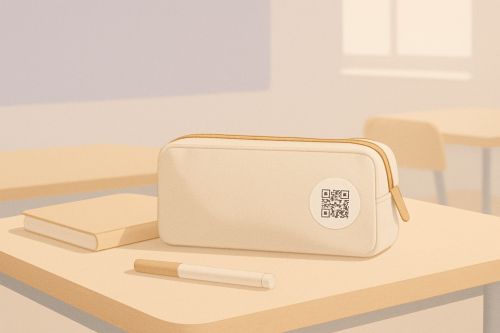
The pencil case falls, the round sticker on the front is visible while the teacher picks it up. She scans it when she has a moment. She learns what, in the daily life of the classroom, overwhelms this small body: the hallway's fluorescent lights, the bell, voices rising in the cafeteria. She doesn't need to change anything about her teaching. She just needs to understand why, on some mornings, the child won't walk into the room.
This situation concerns preschool and primary school students with sensory hypersensitivity, before autism has been explored, or with autism already identified but no MDPH (the French disability agency) notification yet.
The moment as it happened
Five to nine. The bell rings, the hallways stir, the first graders line up. A little girl stays rooted at the gate, her hand gripped in her father's, her head down. The father shrugs at the teacher, with an apologetic smile. The teacher understands, "it's happening again."
She crouches down and offers Eloise a choice: come in through the back door with the AESH (a teaching assistant for students with disabilities, in France) from next door, or wait three minutes for the class to settle. Eloise chooses to wait. The father hands the pencil case to the teacher and points to the sticker: "look at what we put here, it'll tell you everything." The teacher scans it at recess. She learns that the hallway's fluorescent lights double the light from the entrance hall and that it stings, that the bell hurts for ten seconds afterward, that her body needs a buffer.
The next day, she offers the back door, without comment. Eloise walks in.
- You write it
- The QR is in place
- The reader scans
- Understood, without explaining again
Where to place the QR code for this situation
The back of the pencil case is reliable: the pencil case follows the child, it's opened for every written activity, it sits on the table next to the teacher during correction time. A round 2.5 cm sticker on the side that stays visible when the pencil case is laid flat. Choose a discreet color, not bright pink, which invites classmates to pick it up.
Add a second one inside the school bag, in the inner pocket: on days the pencil case stays with the substitute driver or gets forgotten at home, the school bag is there. Avoid the home school diary, which only gets opened for notes. Avoid the notebook cover, which folds and hides the QR code.
For field trips, prepare a card in the coat pocket with the same QR code. Accompanying staff (a riding center, a farm visit, a museum) can scan it without the outing being canceled.
A well placed QR code is never big. A discreet sticker works better than a card worn visibly, which invites questions from classmates.
Pre-written text templates
The three sections below are written from the parent's point of view, for a hypersensitive child without a fixed medical label. You can adapt them based on the dominant sensory particularities (sound, light, touch, smell).
For the "Introduction" section
"Eloise is 6 years old, in first grade (CP). She's hypersensitive to sound and light: things that go unnoticed by others (the bell, fluorescent lights, cafeteria noise) overwhelm her nervous system and can make her refuse to go in, freeze, or cry without a word. She speaks very well, she understands everything, she's not shy."
For the "How to help" section
"You can: offer her a staggered entry through another door right after the bell rings, allow noise canceling headphones in her bag (she knows when to use them), offer a calm corner behind the screen at the back of the classroom, give her a heads up before noisy activities (choir, birthday songs)."
For the "What to avoid" section
"To avoid: telling her she's 'making a fuss,' interpreting her withdrawal as shyness that will pass, forcing her to take part in choir in front of other classes, calling out to her loudly to join the group (that makes the overload worse)."
Conditions related to this situation
This situation is based on isolated sensory hypersensitivity. It also applies to children with autism (hypersensitivity is a common feature there) and children with ADHD, for whom sensory overload is a common trigger for restlessness. The mechanisms are similar, and the QR code placements are the same.
Similar situations
Three other situations where the QR code makes it possible to allow a sensory accommodation without having to negotiate it every time with every adult at school.
The teacher understands why handwriting slows down without mistaking fatigue for lack of effort, and adapts written work from the first week…
View the case Student with ADHD, age 9 Reader: TeacherThe teacher knows from the start of the year that wandering attention isn't a lack of interest, and favors short instructions rather than re…
View the case Middle school student with dyslexia, age 12 Reader: Teacher for each subjectEach subject teacher reads the accommodations (font, extra time, oral format) without the student having to request them at the start of eve…
View the caseThis situation is something you should not have to replay with every new person.
Every new school year, every new substitute, every appointment: you have to start all over again. myHandiQR puts an end to that. You write it once. You will no longer start from scratch at every meeting.