


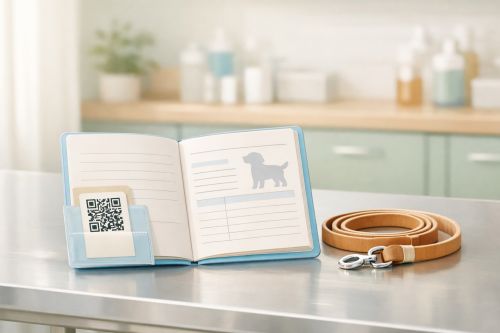
A full waiting room, three questions in a row and a stare that does not let up: the card slipped into the dog's health record teaches the vet to ask one question at a time
A card in the pocket of the health record, scanned by the vet before even petting the dog, and the appointment changes pace: one question, one answer, one announced gesture, then the next.
This case is about an autistic adult who takes their animal to the vet and who prepared their own profile. The reader is the vet or the veterinary assistant who welcomes them.
The lived moment
Tuesday, 6:10 pm. In the clinic waiting room, a parrot screeches, a dachshund pulls on its leash, the automatic door slams every thirty seconds. Nolan, 28, holds the health record of his dog Mirza tight against him. He calculated the route, the parking spot, the length of the appointment. He did not calculate the noise.
The vet opens the consulting room door and says, while flipping through the file: so, what brings her in, is she eating well, drinking, how often do you walk her, are her stools normal? Nolan hears four questions and keeps one. He stares at the stainless steel table. He answers "yes" to the wrong one.
A few seconds earlier, the assistant noticed the card sticking out of the health record pocket and scanned it. The vet read three lines between two files. He closes the binder, sits down, lowers his voice: we will take it slowly. First thing, is she eating well? Nolan finally breathes out.
- You write it
- The QR is in place
- The reader scans
- Understood, without explaining again
Where to place the QR for this case
At the vet, what is opened at every visit is the animal's health record. The QR must travel with it, not with Nolan, because the record is what gets passed from hand to hand across the counter.
- Card slipped into the plastic pocket of the health record, right behind the vaccine page that the assistant always opens first.
- Small sticker on the inside cover of the record, so a replacement or an on-call vet finds it without digging.
- Link emailed to the clinic along with the online appointment booking, so the front desk attaches it to the dog's file.
We rule out the leash or the animal's collar: the QR would be licked, chewed, bent, and the vet has their hands full. We also rule out Nolan's phone, which he often keeps in airplane mode in a noisy waiting room. The record is on the table, it is readable, it stays in the file. myHandiQR is used here to prepare the profile once and for all.
Ready-made text templates
Here are outlines to fill in the profile sections. Rewrite them in your own words: what matters is what you would say yourself to a vet you are seeing for the first time.
For the "Introduction" section
"My name is [first name], I am [age] and I am autistic. I understand what people say to me well, but several questions in a row make me lose the thread. I need time to answer, and I rarely look people in the eye. It has nothing to do with my attention."
For the "How to help" section
"Please ask me one question at a time and wait for the answer. Tell me what you are going to do to my dog before you do it. If the noise rises in the waiting room, offer me to wait outside or in the car: I will come back when you call me."
For the "What to avoid" section
"Please avoid stringing questions together, rushing me when I look for my words and asking me to look at you. Also avoid touching my shoulder to reassure me: announce it first, or do not do it."
Conditions covered by this case
This scenario is first about autism and anxiety. It also applies to people who are very sensitive to noise or who lose their words under pressure, whatever name is given to their particularity.
Similar cases
Other everyday places where a discreet card avoids explaining everything again: a shop, a hair salon, a service counter.
The other person understands the situation right away and adapts how they communicate, without the person having to explain what they can no…
View the case Older adult with Alzheimer's, 78 years old Reader: Passerby, policeIn case of wandering or disorientation, someone can access the emergency information and the family's contacts.
View the case Adult with a cognitive disability, 22 years old Reader: Anyone they turn to when they're stuckThe person can get help without having to explain out loud what they cannot put into words.
View the caseNo need to explain it to every new person.
Three texts (introduction, how to help, what to avoid), one shared QR code. When they scan it, the person reads what they need to know, in their own language.