


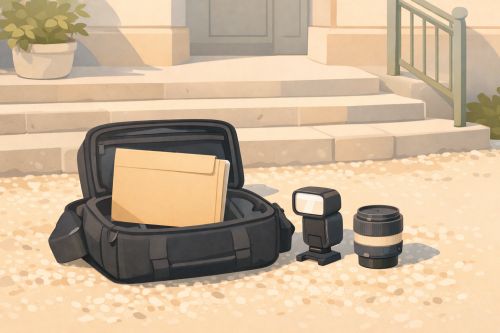
Group shot on the town hall steps, flash and "look at me": the card slipped into the photographer's folder tells them to show the pose before asking for it, and not to put a hand on Elias
A card handed to the photographer before the ceremony, and the "smile, look at me" shouted ten times in a row gives way to a pose shown just once, with no hand on the shoulder and no countdown.
This case concerns a 9-year-old autistic child invited as a ring bearer at his aunt's wedding. The profile is prepared by a parent. It is meant for the person who will direct the group photos, often a professional the family has met once, twice at best.
The moment as lived
Four o'clock, the town hall steps, the low sun on the gravel. The photographer claps their hands: everyone close together, children at the front, all eyes on the lens. Elias, 9, in a grey suit still stiff, holds his shirt collar between two fingers. The off-camera flash pops twice. He steps back, then again, his eyes glued to the ground. "Come on, buddy, a big smile!" A hand lands on his shoulder to bring him back into the row. He freezes, eyes shut, shoulders up to his ears. In the photo, he looks like a sulky child.
His mother had slipped a laminated card into the folder with the list of groups, the one the photographer keeps in hand throughout the session. He had scanned it between two coffees, before the ceremony. Elias understands everything. Direct flash makes him anxious. An unexpected touch makes him close his eyes. A pose has to be shown once, calmly, before it is asked for.
Ten minutes later, the photographer crouches a metre away, shows the pose with their own body, announces "two photos, then we're done" and switches to indirect flash against the light wall. Elias stays in the row, his gaze a little off the lens, and no one holds it against him. The album keeps his real face.
- You write it
- The QR is in place
- The reader scans
- Understood, without explaining again
Where to place the QR for this case
The photographer often arrives alone, with a heavy bag and a tight schedule. The QR must reach them before the group photos, somewhere they open naturally, without having to guess who Elias's family is.
- Laminated card slipped into the folder with the list of groups (the "photos not to forget") that the family hands over at the start of the day: it is the paper they keep in hand throughout the session.
- Link sent by message a few days beforehand, with the schedule of the day, so they have read the profile before arriving.
- Small sticker on the back of the programme held by the aunt or the witness, the person they will ask to gather the children.
- Backup card in the pocket of Elias's jacket, for the adult with him if a second photographer takes over.
Avoid a visible badge on the suit, which singles the child out in front of all the guests, and display in the ceremony booklet, read by the whole room. A card that passes between a few chosen hands is better.
Ready-made text templates
The templates below are a starting point for filling in the profile sections. Make them your own: how your child reacts to a flash or to a hand on the shoulder is yours to describe, and that detail makes the profile useful to someone seeing him for the first time. They are written in myHandiQR.
For the "Introduction" section
"I am the parent of [first name], [age], autistic. He understands everything said to him, but unfamiliar places, sharp noises and sudden lights make him withdraw. He is a ring bearer at the wedding of [relationship]. For him, the photos are a long and noisy moment."
For the "How to help" section
"Show the pose before asking for it, just once, in simple words. Say how many photos there will be: two, then we're done. Prefer daylight or indirect flash. Speak to him before coming closer and let his gaze rest where he feels comfortable."
For the "What to avoid" section
"Do not touch him to place him. Avoid direct flash up close, the countdown and repeated "smile" calls. Do not make him redo a photo whose smile seemed a failure: he would withdraw even more."
Conditions covered by this case
The situation also applies to children who are hypersensitive to lights and touch, and to those who struggle with instructions repeated in front of a crowd. The profiles below explain each particularity to the photographer, at the right level.
Similar cases
The photographer is not the only adult to meet a child on the very day. These other cases show how a QR placed in the right spot prepares those who welcome him.
The other person understands the situation right away and adapts how they communicate, without the person having to explain what they can no…
View the case Older adult with Alzheimer's, 78 years old Reader: Passerby, policeIn case of wandering or disorientation, someone can access the emergency information and the family's contacts.
View the case Adult with a cognitive disability, 22 years old Reader: Anyone they turn to when they're stuckThe person can get help without having to explain out loud what they cannot put into words.
View the casePrepare your profile for this situation, without having to explain it again every school year.
You write down the essentials once. The grading teacher, the AESH (a teaching assistant for students with disabilities, in France), the substitute scan and understand. You stop repeating yourself.