


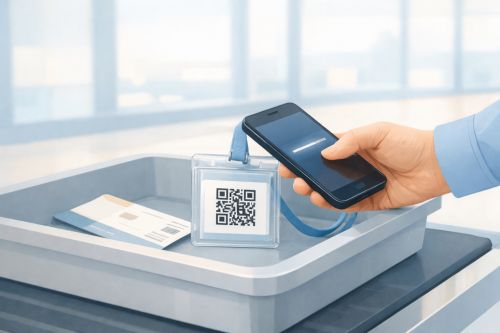
Belt, watch, phone, everything in the tray: the card tucked behind the boarding pass teaches the security officer to give one instruction at a time
A card kept in the neck pouch, behind the boarding pass, read by the officer before the walk-through scanner, and the list "jacket, belt, watch, phone" breaks down into gestures shown one by one, instead of being repeated louder in front of an impatient line.
This case is about Marius, 19, who has Down syndrome and flies alone to join his father in Nantes. The profile was prepared by his mother. It is meant for the officers at the security screening checkpoint, and more broadly for all ground staff who come across a passenger travelling alone.
The moment as it happened
Terminal 1, 7:40 a.m. The flight to Nantes closes in fifty minutes. In front of the conveyor belt, Marius holds his backpack tight against him. The officer reels off the sentence he has already said two hundred times this morning: jacket, belt, watch, phone in the tray, liquids separately, move along. Behind, someone sighs. Marius puts down his jacket. Then nothing. He stares at the empty tray as if waiting for the rest of a sentence that has already ended.
At the boarding pass check, he handed over his boarding pass, and with it the small card tucked into the same pouch. Yanis, the officer, scanned it. Three lines written by Céline, his mother: he understands everything, one instruction at a time. Point to the item. Warn him before touching him.
Yanis points to the belt. Waits. Then the watch. At the walk-through scanner, it beeps anyway, the rivet on his jeans. "I’m going to run my hand along your arms, then your back, okay?" Marius nods and raises his arms on his own. Barely forty seconds more. The line hardly noticed a thing.
- You write it
- The QR is in place
- The reader scans
- Understood, without explaining again
Where to place the QR for this case
At security, almost everything you carry ends up in a tray and goes through the X-ray. So the QR has to stay on the person, within the officer’s reach, at the exact moment the officer is already looking at a document.
- A card in a clear neck pouch, slipped just behind the printed boarding pass. The officer sees it at the boarding pass check, even before the conveyor belt. Choose a lanyard without a metal clip, otherwise it will beep at the scanner.
- A copy in the passport or ID card, for the boarding gate agent and for the assistance team that accompanies Marius to his seat.
- The link attached to the assistance request made to the airline a few days before departure, so that the person who comes to meet him at the desk has read the profile before meeting him.
- To avoid: the phone case and the cabin bag tag, which go into the X-ray tunnel at the exact moment they would be needed, and the jacket pocket, since the jacket goes into the tray first.
Nothing is written on the pouch. It signals nothing to other passengers, only the QR shows that there is something to read.
Pre-written text templates
These outlines are a starting point for the three sections of the profile. Rewrite them in your own words: you are the one who knows how your child shows they need an extra second. The profile can be edited at any time from your myHandiQR space, even the day before the flight.
For the "Introduction" section
"I am Marius’s mother. He is 19 and has Down syndrome. He travels alone, he knows his route and he understands what people tell him. What stops him is a list of instructions given all at once, especially when things move fast around him."
For the "How to help" section
"Give one instruction at a time and point to the item: the belt, then the watch, then the phone. Give him a few seconds. Before a pat-down, tell him where you are going to put your hand. If he nods, he has understood and he will do it."
For the "What to avoid" section
"Don’t repeat the same sentence louder or faster, it makes him freeze even more. Don’t touch him without warning him first. Don’t talk about him to the person behind as if he couldn’t hear: he hears everything."
Conditions covered by this case
This case starts from Down syndrome in a young adult travelling alone. The same card also works for an autistic person thrown off by the noise of the conveyor belt, or for someone whose anxiety rises as soon as they join the line.
Similar cases
Other transport situations where a well-placed card saves you from explaining everything, at the ticket desk, on the platform or on board, with travellers of all ages.
The other person understands the situation right away and adapts how they communicate, without the person having to explain what they can no…
View the case Older adult with Alzheimer's, 78 years old Reader: Passerby, policeIn case of wandering or disorientation, someone can access the emergency information and the family's contacts.
View the case Adult with a cognitive disability, 22 years old Reader: Anyone they turn to when they're stuckThe person can get help without having to explain out loud what they cannot put into words.
View the case