


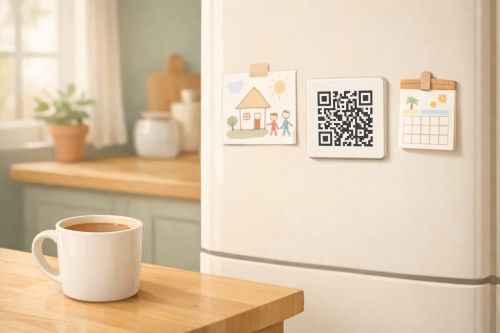
A week at Grandma and Grandpa's, and Lila sometimes zones out for two seconds: the card on the fridge teaches them to watch calmly instead of panicking
A magnet on the fridge, a card in the travel pouch: grandmother and grandfather scan once, calmly, and understand what those two seconds mean when Lila stops in the middle of a sentence.
This case is about an 8-year-old girl with epilepsy, left for a few days with her grandparents. The profile is written by a parent, and it speaks to people who love the child but have never seen a seizure up close.
The moment as it happens
Tuesday, 10:40 a.m., the kitchen smells of brioche. Lila is writing a postcard to her parents, pen in the air, and then nothing. Eyes open, fixed, chin slightly raised. No fall, no sound. Grandpa looks up from his newspaper and calls her twice. She does not answer. He gets up, the chair scraping on the tiles.
Grandma scanned the magnet on Sunday evening, after the parents had left, while peeling potatoes. She read that absences last a few seconds, that you do not shake the child, that you note the time and wait. She puts a hand on her husband's shoulder. "Twenty to eleven, we watch." Ten seconds later, Lila blinks and picks up her sentence where she left it.
That evening, Grandpa sends the parents a message with the time and the duration. No panicked phone call, no early drive back. The postcard went out the next day.
- You write it
- The QR is in place
- The reader scans
- Understood, without explaining again
Where to place the QR code for this case
Grandparents do not live with a phone in hand, and they will not find a paper tucked into a suitcase. The QR code should be where they pass twenty times a day, without the child feeling singled out.
- Magnet on the refrigerator door, on the hallway side rather than the table side, so it works without being stared at by the cousins.
- Card in the travel pouch, with the prescription and the health record, for the trip to the pool or the picnic at the aunt's.
- Card handed directly to the neighbor or the Thursday babysitter, who looks after the child without the parents having had time to brief her.
- Not suitable: the cuddly toy, the backpack, the visible bracelet. An 8-year-old sees everything and does not want to be a "case" in other people's eyes.
One QR code per place of stay is enough, and the same profile serves every adult taking turns around the table.
Ready-made text templates
A few outlines to fill in the profile sections. Rewrite them in your own words: the way your child behaves just before and just after is what will help the grandparents most.
For the "Introduction" section
"I am Lila's father, she is 8. She has epilepsy followed by her neurologist. She sometimes has absences: a few seconds where she stops, staring, without reacting. The rest of the time she is fine, she runs, she swims, she loves cooking. She is a little tired after these moments."
For the "How to help" section
"Stay close to her, speak softly, note the time. Let her come back to herself without rushing her. If the seizure is different from usual or lasts more than five minutes, call the emergency services (15 in France), then us. The doctor's protocol is in the blue pouch of the travel kit. Put her to bed at the usual time."
For the "What to avoid" section
"Do not shake her, do not shout at her to make her react. Do not put anything in her mouth. Avoid short nights and late-evening screens, which make seizures more likely. Do not leave her alone in the bath or at the pool, even for a moment."
Conditions covered by this case
Epilepsy is the directly linked page. The same card works for other particularities that require grandparents to know what to watch for, what to do and what to avoid without any training, such as some forms of childhood diabetes or sleep disorders.
Similar cases
The cases below tell the stories of other adults who welcome a child or a relative into their home, with a simple instruction at hand and nobody to ask.
The other person understands the situation right away and adapts how they communicate, without the person having to explain what they can no…
View the case Older adult with Alzheimer's, 78 years old Reader: Passerby, policeIn case of wandering or disorientation, someone can access the emergency information and the family's contacts.
View the case Adult with a cognitive disability, 22 years old Reader: Anyone they turn to when they're stuckThe person can get help without having to explain out loud what they cannot put into words.
View the caseThis situation is something you should not have to replay with every new person.
Every new school year, every new substitute, every appointment: you have to start all over again. myHandiQR puts an end to that. You write it once. You will no longer start from scratch at every meeting.