




Child with DLD at a library workshop, age 6
A reading-for-pleasure workshop at a children's library means a librarian asking questions, children answering, a fast-moving spoken rhythm. A child with DLD (developmental language disorder) who is taking part stays silent for longer than the others. The librarian may read that silence as disinterest and stop calling on him. The form handed over at sign-up for the workshop, scanned before the first book: the librarian adjusts the response time, offers written alternatives, and keeps the child part of the conversation.
This case applies to children with DLD (developmental language disorder, formerly called dysphasia) enrolled in a library workshop, often in the early years of elementary school.
The moment as it happened
The municipal library, Saturday morning "reading aloud" workshop, early elementary years. Eight children sit in a circle on cushions. The librarian reads "The Great Black Panther" and asks questions. "What did the panther do when she saw the little boy?" Hands go up. She calls on two children. She turns to Yanis. "And you, Yanis, did you see what she did?" Yanis opens his mouth, searches for words, and closes it again.
The librarian waits two seconds. Two seconds is already a long time in a workshop. She smiles and moves on to another child. Yanis looks down at his knees.
The father arrives at the end of the workshop. He hands the librarian a form: "this might help for next week." She scans it. She learns that Yanis has DLD, that he understands everything, that he loves stories, that he takes 10 seconds on average to put together a spoken answer, and that he can be offered the option of pointing to the answer in the book or drawing what he understood.
The following Saturday, she asks Yanis last, she waits, and she offers him the chance to point at the picture that answers the question. He points. He smiles.
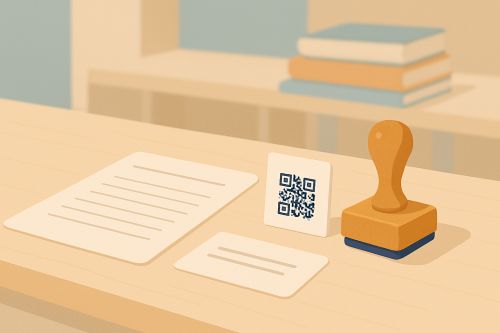
- You write it
- The QR is in place
- The reader scans
- Understood, without explaining again
Where to place the QR code for this case
An A5 sheet handed to the librarian at sign-up for the workshop, slipped into the paper registration file. A 2.5 cm round sticker on the child's library card (the item he presents at every workshop).
Duplicate it in the library bag the child uses to carry his borrowed books. Avoid emailing the library: it doesn't reach the workshop librarian. Avoid posting forms on the workshop wall: they expose the child to his peers.
For one-off events (story time, shows, author signings), the sticker on the library card serves as the anchor: the card is shown at the entrance of every event.
Worth considering: the form can also be shared among librarians across the same town (with parental consent), so the child doesn't have to start from scratch every Saturday depending on who is on duty.
Pre-written text templates
The three templates below are written from the parent's side, in consultation with the child's speech therapist. Medical vocabulary is present but always translated into a concrete action for the librarian.
For the "Introduction" section
"Yanis, 6 years old, first grade. Developmental language disorder diagnosed at age 4 by a speech therapist at a CRA (a regional autism resource center in France). He understands everything he's read, he loves stories, he asks questions at home. In a group, he takes 10 seconds to put together a spoken answer. He is a curious child who needs time, not a child who isn't listening."
For the "How to help" section
"You can: ask him the question last so he has time to prepare, offer him the option to point at a picture in the book to answer, invite him to draw what he understood of the story, value his answer even if it comes after 15 seconds, pair him with a calm partner for shared reading."
For the "What to avoid" section
"To avoid: moving on to the next child after 2 seconds of silence, finishing his sentence for him, saying so, you don't know?, putting him in front of everyone and asking him to summarize, reading his silence as disinterest (he loves stories), excluding him from the workshop because he doesn't participate."
Conditions related to this case
This case is built around DLD (formerly called dysphasia). It also applies to children with severe stuttering (who get stuck on certain words), children with dyslexia who are learning to read and don't dare answer out loud, and deaf children with hearing aids who follow the workshop from a distance.
Similar cases
Three other cases where the QR code lets a cultural facilitator (librarian, guide, workshop leader) keep every child part of the conversation, including those who answer slowly.
The youth worker includes the child in group games by anticipating risky moments (transitions, waiting times), without punishing restlessnes…
View the case Teen with social anxiety at summer camp, age 12 Reader: Summer camp director, activity leaderThe camp staff identify risky moments (large groups, noisy evening activities) and offer discreet ways to step back without stigmatizing the…
View the case Deaf child in a sports club, age 9 Reader: Sports coachThe coach adjusts instructions (visual cues, gestures, signaling exercises) so the child isn't left out from missing a spoken request.
View the case