


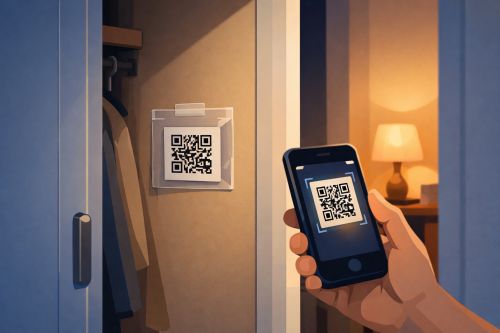
Low light, a single voice: the pouch behind the front door prepares the CMP mobile crisis team before the first word
A pouch taped inside the hall cupboard, scanned on the landing by the nurse from the mobile crisis team, and Inès doesn't have to explain in the middle of the night why her sister no longer answers, why the ceiling light has to go off and why only one person should speak to her.
This case is about Nadia, 26, autistic, who loses her speech when anxiety overflows. The profile was prepared by her sister, with her, on a calm day. It is meant for the mobile crisis teams attached to the CMP (a French public mental health centre) who come to people's homes.
The moment itself
Thursday, 10:40 pm, second floor of a building in Villeurbanne. Nadia is sitting on the floor in the hallway, her back against the radiator, her hood pulled down over her eyes. She is rocking. Hands over her ears. For an hour she has only answered with nods, and sometimes not at all. Her sister Inès finally called the number of the CMP (a French public mental health centre) mobile crisis team, the one their local service gave them in the spring.
Karim and his fellow nurse ring the bell at 11:15 pm. Before they come in, Inès opens the hall cupboard and shows them the pouch. Karim scans it. Thirty seconds of reading on the landing: Nadia is autistic, she stops speaking when anxiety rises, one voice only, no ceiling light, no hand on the shoulder.
He switches off the hallway light and leaves the living room lamp on. His colleague stays in the kitchen with Inès. He sits on the floor, two metres away. One question at a time. A yes or no question. Then silence. Twenty minutes later, Nadia reaches for the tablet next to her and types four words: "too much noise today". The conversation has just begun.
- You write it
- The QR is in place
- The reader scans
- Understood, without explaining again
Where to place the QR code for this case
A crisis like this almost always happens at home, in the evening, when the day has already taken everything. So the QR code has to be found by a panicked relative in under ten seconds, and read by the team before they cross the threshold, without Nadia having to do anything.
- A plastic pouch taped inside the door of the hall cupboard, at eye level, with the number of the mobile crisis team and the family doctor's number next to it: it's the first thing Inès reaches for when she opens the door.
- A copy of the link saved as a favourite on Inès's phone and on their mother's, for crises that happen somewhere other than the flat.
- A card slipped into the follow-up file given to the CMP, so the referring nurse can share the link with colleagues on duty.
- Ruled out: the outside of the front door. The neighbours don't need to know how Nadia works, and a label on the door draws questions she doesn't want.
- Ruled out: the handbag only. In the middle of a crisis, nobody will go through Nadia's things, and she can't bear anyone touching them.
The profile replaces neither the crisis plan drawn up with the care team nor any treatment. It simply avoids spending the first minutes asking questions that cannot be answered.
Pre-written text templates
Go through these outlines with the person concerned, at a time when everything is fine. Keep it to the point: the team reads on a landing, often at night. You can adjust the profile after each intervention from your myHandiQR space.
For the "Introduction" section
"Nadia is 26, she is autistic and works in a media library. When anxiety overflows, she loses her speech for a while, sometimes an hour. She hears and understands everything. She can answer yes or no with her head, or write on her tablet."
For the "How to help" section
"Only one person speaks to her, the others stay in another room. Switch off the ceiling light, keep one lamp on. Sit at a distance, at her level. Ask one yes or no question at a time and wait. Leave the tablet within reach, that's how the words come back."
For the "What to avoid" section
"Touching her without warning, even to reassure her. Several people talking at once. A torch shone in her eyes. Asking her to look at you or to 'make an effort to speak'. Insisting that she gets up right away: she will get up when she can."
Conditions covered by this case
This case is about autism in an adult woman and the intense anxiety that can take away speech during a crisis. It also applies to a person with selective mutism, marked sensory hypersensitivity or ADHD with strong emotional overflows.
Similar cases
The cases below share the same urgency: responders who arrive without knowing the person, and a few minutes to avoid the gesture that makes everything worse.
The dentist understands the sensory sensitivities (chair noise, light, texture) and offers useful adaptations (headphones, breaks) without d…
View the case Adult with sensory sensitivity, age 45 Reader: Self-employed nurseThe nurse adjusts her presence (soft voice, announced gestures, no perfume) without having to discover the needs during a first crisis, whic…
View the case Child with FASD, age 10 Reader: PediatricianThe pediatrician knows about the fetal alcohol spectrum disorder from the outset and avoids convenience diagnoses or unsuitable referrals du…
View the caseNo need to explain it to every new person.
Three texts (introduction, how to help, what to avoid), one shared QR code. When they scan it, the person reads what they need to know, in their own language.