






Older adult with early-stage Alzheimer's, age 74
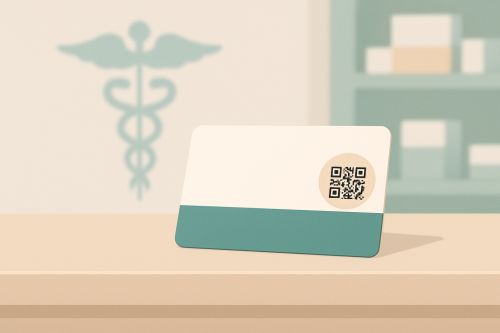
An elderly woman arrives alone at the pharmacy with her doctor's prescription. The pharmacist notices she just came in, that she is asking for a box of medication she already has. Without any information, she either hands over the box or awkwardly refuses. The QR code on the back of the health insurance card allows a discreet check and a suitable response, without exposing the person at the counter in front of other customers.
This case applies to elderly people with early or moderate Alzheimer's, living at home, going out alone to run errands and to the local pharmacy.
The moment as it happens
A neighborhood pharmacy, 10am. A 74 year old woman, beige suit, vintage handbag, sets her prescription and health insurance card on the counter. "A refill of my Kardegic." The pharmacist checks the prescription: Kardegic isn't on it. She checks the woman's history: she came in yesterday and picked up three boxes of Kardegic. The pharmacist knows how this usually goes, she generally refuses politely. The woman insists, her voice trembling slightly.
The pharmacist picks up the health insurance card and turns it over to check the coverage start date. She notices the small sticker on the back, with a printed QR code and the note "please scan if in doubt." She swipes the card under the reader just as she is about to reach for the woman's usual bag of medication. She scans the QR code discreetly, under the counter. In twenty seconds she reads: Marguerite, early Alzheimer's diagnosed in 2024, contact daughter (number), pill organizer set up by the daughter every week, do not hand out medication without calling the daughter first.
The pharmacist says, "let me check the order with your daughter, two minutes." Marguerite sits down in the chair. The pharmacist calls the daughter, who confirms the pill organizer is in place and no refill is needed. Marguerite leaves with a nice cotton bag full of cream samples, at ease, without having been humiliated.
- You write it
- The QR is in place
- The reader scans
- Understood, without explaining again
Where to place the QR code for this case
The back of the health insurance card is the most reliable spot: the card always stays with the person, it gets presented at every medical and pharmacy visit, and it is handled by the professional (not the patient themselves). A 2 cm round sticker, printed by the contact daughter or the family doctor.
Duplicate it in the wallet as a business card sized card (with the note "if confused, scan"), and at the entrance of the home (a card pinned inside the door for home emergency responders).
Avoid visible alert bracelets: they expose the person in public. Avoid stickers on the handbag: the bag could be lost or stolen.
The contact daughter can also leave a printed sheet with the QR code at the regular pharmacy, to be attached to the mother's paper file (an informal agreement between the pharmacy and the family). This lets the whole pharmacy team (including pharmacy technicians) scan it whenever in doubt.
Pre-written text templates
The three templates below are written by the adult child (the contact daughter, in this case), with the mother's agreement whenever she is still able to give it, early in the illness. The tone stays respectful, never patronizing.
For the "Overview" section
"Marguerite, 74 years old, widow, lives alone in her apartment in the 15th arrondissement. Early Alzheimer's diagnosed in June 2024, MMSE score 22/30. Taking Aricept 10 mg. Independent for errands and personal care. Occasional confusion about her medication. Contact daughter: Anne, 06 XX XX XX XX."
For the "How to help" section
"You can: call me before handing out any medication not in the pill organizer, speak to her in a normal, calm voice (she is not hard of hearing), give her time to pay, walk her to the pharmacy door if she seems disoriented, let me know about any unusual behavior, keep a record of repeated requests."
For the "What to avoid" section
"What to avoid: refusing bluntly at the counter in front of other customers, raising your voice to be 'clearly understood', telling her 'you already came in' without any tact (she won't remember), sending her home without calling ahead, giving her medication just to avoid upsetting her (dangerous)."
Conditions related to this case
This case is based on early to moderate Alzheimer's disease. It also applies to vascular dementia (after repeated strokes), Lewy body dementia, and frontotemporal dementia in people over 65 who are still independent enough to run their own errands.
Similar cases
Three other cases where the QR code lets a local shopkeeper (pharmacist, baker, hairdresser) offer support without exposing the person in front of other customers.
The dentist understands the sensory sensitivities (chair noise, light, texture) and offers useful adaptations (headphones, breaks) without d…
View the case Adult with sensory sensitivity, age 45 Reader: Self-employed nurseThe nurse adjusts her presence (soft voice, announced gestures, no perfume) without having to discover the needs during a first crisis, whic…
View the case Child with FASD, age 10 Reader: PediatricianThe pediatrician knows about the fetal alcohol spectrum disorder from the outset and avoids convenience diagnoses or unsuitable referrals du…
View the caseNo need to explain it to every new person.
Three texts (introduction, how to help, what to avoid), one shared QR code. When they scan it, the person reads what they need to know, in their own language.