


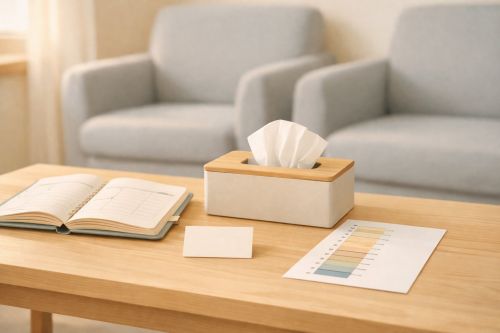
Words come after ideas: the card tucked into her planner prepares the psychologist before the first question
A card handed over by Nora as she sits down, scanned by the psychologist before the first "so, what brings you here?", and the long silences stop being read as shutting down: short questions, time, a visual aid within reach.
This case is about Nora, 14, in Year 9, who has DLD (developmental language disorder), a particularity of spoken language. The profile was written by her mother. It is aimed at psychologists in private practice who see a teenager for the first time, in a setting where almost everything goes through speech.
The moment as it happened
Wednesday, 4:40 pm, a practice on the first floor, above a pharmacy. Two grey armchairs, a box of tissues, a clock you can't hear as long as someone is talking. Nora keeps her bag on her lap. Before sitting down, she takes a card out of her planner and places it on the coffee table. Sophie, the psychologist, scans it without a word.
She reads. Nora understands everything, but takes a long time to find her words, especially when the question is long or contains two questions at once. She may answer off the point because she only held on to the end of the sentence. Sophie taps "DLD", skims the version written for care professionals, and lays the phone face down on the table.
Her first question is six words long. She waits. Fifteen seconds, maybe more. Nora eventually points to the 7 on the scale from 1 to 10 that Sophie slid towards her. The rest of the session moves forward like that, in small pieces. As she leaves, Nora says "see you Wednesday" without being asked.
- You write it
- The QR is in place
- The reader scans
- Understood, without explaining again
Where to place the QR for this case
With a psychologist, the QR needs to be read before the session really starts, that is, before the first open question. After that, it's too late: the first silences have already been interpreted. It's also better if the teenager hands it over herself, rather than a parent speaking for her in the waiting room.
- Card tucked inside the cover of her school planner: Nora always has it with her and can take it out without having to justify herself.
- Link sent by her mother when booking the appointment, by text message or through the booking platform, so the psychologist can read it the day before.
- Copy in the folder holding the doctor's letter and the speech therapist's reports, if the family brings them.
- Ruled out: the phone case. In many practices, the phone stays put away during the session, and taking it out becomes a topic in itself.
- Ruled out: the bracelet or the key ring. Too visible for a Year 9 pupil who doesn't want to be asked about it at school.
The profile replaces neither the speech therapy assessment nor the PAP (a personalised support plan at school, in France) set up at her school. It gives the psychologist what she needs so as not to read a silence as an answer.
Pre-written text templates
These outlines are a starting point for filling in the profile sections. Rework them in your own words, or better still, in your child's words when possible: it's their own way of searching for sentences that needs describing. You can edit the profile whenever you like from your myHandiQR space.
For the "Introduction" section
"Nora is 14, she is in Year 9. She has DLD: she understands what people say to her, but it takes her time to find her words and build her sentences. When she is stressed, it shows even more. She chose to come, even if she says little at first."
For the "How to help" section
"Ask only one question at a time, in simple words. Give her time, even if the silence feels long. Offer her the option to show, draw, write a word or choose on a scale. Rephrase what you understood and let her correct you."
For the "What to avoid" section
"Avoid double or very long questions. Avoid finishing her sentences for her. Avoid taking a silence as a refusal or a lack of willingness. Avoid turning to the adult who came with her to get the answer."
Conditions covered by this case
This case is about DLD, and the apprehension that builds on it when the whole exchange relies on speech. It also applies to a teenager with selective mutism, an adult with aphasia after a stroke, or a young autistic person who needs time to answer.
Similar cases
The cases below share the same mechanism: a professional seeing someone for the first time, in a setting where language does almost all the work.
The dentist understands the sensory sensitivities (chair noise, light, texture) and offers useful adaptations (headphones, breaks) without d…
View the case Adult with sensory sensitivity, age 45 Reader: Self-employed nurseThe nurse adjusts her presence (soft voice, announced gestures, no perfume) without having to discover the needs during a first crisis, whic…
View the case Child with FASD, age 10 Reader: PediatricianThe pediatrician knows about the fetal alcohol spectrum disorder from the outset and avoids convenience diagnoses or unsuitable referrals du…
View the caseThis situation is something you should not have to replay with every new person.
Every new school year, every new substitute, every appointment: you have to start all over again. myHandiQR puts an end to that. You write it once. You will no longer start from scratch at every meeting.