






Deaf child in a sports club, age 9
A deaf child with hearing aids in an ordinary sports club (soccer, judo, dance) follows the coach's verbal instructions with a delay, or not at all. He watches what the others do, copies them, and misses the start of the exercise. A card given to the coach at sign-up, scanned before the first warm-up: instructions become visible, technical movements are shown as well as spoken.
This case applies to deaf or profoundly hard-of-hearing children, with or without cochlear implants or hearing aids, taking part in a sport at an ordinary club.
The moment as it happened
A judo hall, first class of the season. The coach lines the children up on the white line. "We start with a lap of the mat, legs up in the air." Twenty-three children set off. One stays on the line, looking at his feet. The coach thinks he didn't hear, and raises his voice: "come on, run!" The child doesn't move. The coach starts to lose patience.
The father arrives late and hands the coach a card: "before you tell him off, this is worth a look." The coach scans it while the others finish their lap. He learns that Marius has profound hearing loss from birth, that he wears hearing aids but they don't pick up sound well in a dojo (echo), that he needs to be spoken to face to face with each exercise shown, and that he reads lips if the lighting is good.
The coach turns back to face Marius, points at the mat, mimes running, points to a child who is running, then points to himself and gives a thumbs up. Marius sets off. He does his lap. He comes back smiling.
- You write it
- The QR is in place
- The reader scans
- Understood, without explaining again
Where to place the QR code for this case
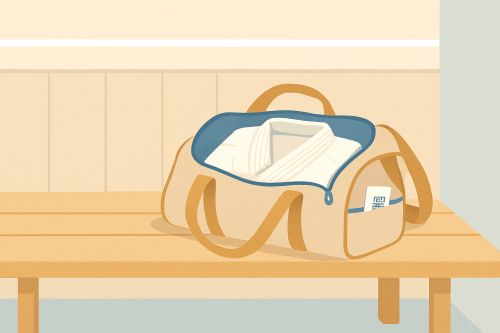
A card handed to the coach at sign-up, with the note "for the team working with him." The card stays in the club binder, on the child's registration sheet. Duplicate it in the sports bag, outer pocket, as a sticker.
Avoid stickers on sportswear or on the judo uniform: they get in the way, they're visible to other children (possible teasing), and they wear off with washing. Avoid necklaces with a QR code during activity (dangerous in judo, soccer, gymnastics).
For camps or tournaments where the usual coach isn't there, the sticker on the sports bag lets a substitute coach scan it in the hall. For competitions, a duplicate QR code can be slipped into the sports passport given to the organizers.
Also worth considering: the card can carry a visible sentence even without scanning ("Marius is deaf, speak facing him"), for emergencies where there's no time to scan.
Pre-written text templates
The three templates below are written from the parent's side. The vocabulary mixes practical observations with minimal technical reminders (positioning, distance, lighting) that help the coach adjust how they communicate.
For the "Introduction" section
"Marius, 9 years old, has done judo for 2 years. Profound hearing loss from birth, wearing hearing aids in both ears since 2019 (BTE Phonak devices). He can hear some speech face to face in a quiet environment, but he cannot pick out sound from the general noise of a dojo. He reads lips in French. The family communicates using cued speech (LPC)."
For the "How to help" section
"You can: position yourself facing him for any important instruction, show the technical move before saying it, pair him with a partner who will repeat it visually, keep your face lit (not backlit), write complex sequences on the board, give him 3 seconds to understand before rephrasing."
For the "What to avoid" section
"To avoid: raising your voice (it doesn't change anything), talking to him from behind or while walking, calling out to him across the room, playing hip-hop music in the background during instructions, placing him at the back of the group, saying "he's distracted" (he simply can't hear you), comparing him to hearing peers on speed of execution."
Conditions related to this case
This case is built around bilateral profound hearing loss with hearing aids. It also applies to moderate hearing loss without hearing aids, cochlear implants (bilateral or unilateral), and central auditory processing disorders (where the person hears physically but struggles to process complex sounds).
Similar cases
Three other cases where the QR code lets a sports coach adjust their communication without leaving the child behind at the starting line.
The youth worker includes the child in group games by anticipating risky moments (transitions, waiting times), without punishing restlessnes…
View the case Teen with social anxiety at summer camp, age 12 Reader: Summer camp director, activity leaderThe camp staff identify risky moments (large groups, noisy evening activities) and offer discreet ways to step back without stigmatizing the…
View the case Child with sensory sensitivity at the school canteen, age 7 Reader: After-school activity leaderThe staff member seats the child at a quiet table and offers noise cancelling headphones for the canteen, so the feeling of overload doesn't…
View the caseNo need to explain it to every new person.
Three texts (introduction, how to help, what to avoid), one shared QR code. When they scan it, the person reads what they need to know, in their own language.