






Student with ADHD supported by a shared AESH, age 8
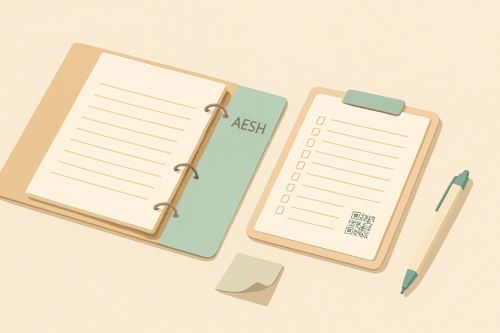
A shared AESH (a teaching assistant for students with disabilities, in France) follows three to five different students in the same school. She doesn't have time to meet every family at the start of the year, she takes up her post on a path already laid out by the one before her, or not. The QR code in the AESH binder passed on to the referring teacher gives her, in five minutes, what would otherwise take five weeks to discover.
This situation concerns primary school students with ADHD and a shared AESH for a few hours a week.
The moment as it happened
A staggered start to the year, a shared AESH (a teaching assistant for students with disabilities, in France) arrives in mid September. She takes over the AESH binder left by the one before her, with the administrative sheets for each student she'll be following. On the first page of Tom's file, a sticky note with a QR code: "scan this, it's more useful than last year's PPS (individualized schooling plan, in France)." She scans it in the staff room, before her first hour.
She learns that Tom has ADHD, that he can manage twenty minutes of focused work followed by two minutes of active break (fetching the chalk, going to the bathroom, unrolling the world map), that his parents tried the Time Timer visual timer and it works, that a stress ball is allowed in his left hand but not fidget toys in class (noise).
She takes the Time Timer out of the dedicated bag, places it on Tom's desk for the first session. Twenty minutes. Break. Twenty minutes. The rhythm is there from day one.
- You write it
- The QR is in place
- The reader scans
- Understood, without explaining again
Where to place the QR for this case
The AESH (a teaching assistant for students with disabilities, in France) binder is the convergence point: it passes between the regular AESH, the substitute AESH, the referent teacher, and sometimes the classroom teacher. It lives on the teacher's desk or in the teacher's cupboard.
A round 4 cm sticker on the divider of each student being followed, at the top of their section: impossible to miss when opening the binder to take follow-up notes.
Avoid loose sticky notes, which fall off and get lost. Avoid a paperclip on the first page, it slips and tears the paper. Avoid the binder cover, which belongs to the school and sometimes changes from year to year.
For handover moments between the regular AESH and the substitute, the printed sheet with the QR can also be left in the teacher's cupboard, while waiting for the substitute to pick up the binder.
Worth duplicating, for students moving into sixth grade (6e, the first year of secondary school), in the school diary with the family's agreement: the secondary school AESH does not necessarily have access to the binder.
Pre-written text templates
The three templates below are designed for shared AESH (a teaching assistant for students with disabilities, in France) support. They leave the AESH the room to adapt that she needs across the 24 hours of a schedule she does not control.
For the "Presentation" section
"Tom is 8 years old, in third grade (CE2). He has combined ADHD diagnosed at age 6, and shared AESH (a teaching assistant for students with disabilities, in France) support 6 hours a week. He is quick, talkative, curious, he likes having the why explained to him. What is costly: continuous written work, passive listening, waiting between two exercises."
For the "How to help" section
"You can: set the Time Timer for 20 minutes to frame work periods, plan a short active break every 20 minutes, break instructions into three visible lines, allow the silent anti-stress ball, pair him with a calm partner, leave a notepad so he can jot down the questions he'll have at the end."
For the "What to avoid" section
"To avoid: the fidget spinner that makes noise (it distracts the others), recess taken away as punishment (moving helps him), public reprimands said out loud, long transitions with no time indication, saying 'you're not making an effort' when he has just held on for 25 minutes."
Disabilities and conditions this case applies to
This case starts from combined ADHD with AESH (a teaching assistant for students with disabilities, in France) support. It also applies to ADD without hyperactivity (less visible, just as exhausting for the student) and to ADHD with a dys comorbidity, with adjustments in the text to include dys-related accommodations.
Similar cases
Three other cases where the QR replaces the handwritten note passed between two AESH (teaching assistants for students with disabilities, in France), with content that stays up to date and isn't disfigured by successive copies.
The substitute AESH identifies the sensory triggers, routines, and warning signs of a meltdown, and avoids making an overload worse by disco…
View the case Student with controlled epilepsy, age 7 Reader: AESHThe AESH knows what to do in case of a seizure (position, how long to wait before alerting others, contacts) without having to search for a …
View the case Student with dyspraxia in year 7, age 11 Reader: AESHThe AESH knows when to help technically (formatting, breaking down instructions) and when to let the student work things out alone, without …
View the caseThis situation is something you should not have to replay with every new person.
Every new school year, every new substitute, every appointment: you have to start all over again. myHandiQR puts an end to that. You write it once. You will no longer start from scratch at every meeting.