






Student with autism (level 2 ASD), age 10
A substitute AESH (a teaching assistant for students with disabilities, in France) arrives with two days' notice to cover a sick leave. The regular AESH left no note, or one that was too brief. The autistic student (level 2 ASD) doesn't talk much, works by routine, and signals being overwhelmed through cues that need to be recognized. The QR in the child's backpack saves the first two days.
This case concerns level 2 ASD students in mainstream school or in a ULIS unit (a specialized inclusion unit within a mainstream school, in France), with full-time or part-time individual AESH support.
The moment as it happened
Tuesday morning, the substitute AESH starts her post with no handover. She's told "it's Rayan, you'll see, he's easy". At recess, Rayan walks around the covered playground, gently rocks his hands, doesn't play with the others. The AESH thinks he's "just being autistic". At 11am, in the classroom, when the teacher asks the class to put away their notebooks before lunch, Rayan stays frozen over his open maths notebook. The teacher insists, the AESH gently pulls the notebook away. Rayan screams and hits the table.
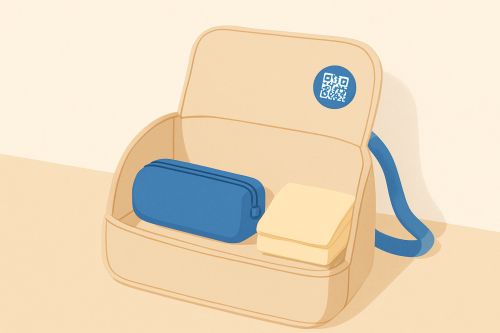
In Rayan's backpack, which the AESH opens to find his bib, she sees the round sticker inside the pocket. She scans it. She learns that Rayan needs a visual signal two minutes before each activity change (a picture of the cafeteria placed next to the notebook), that he rocks his hands when regulating himself, that he starts screaming when an object is taken from him without warning, and that it's best to close his notebook with him, step by step.
The next day, at 10:58, she places the cafeteria picture on Rayan's table. He looks at it. He closes his notebook himself. He stands up.
- You write it
- The QR is in place
- The reader scans
- Understood, without explaining again
Where to place the QR for this case
The child's backpack, inside pocket on the front, top left. That's where the AESH (a teaching assistant for students with disabilities, in France) and teachers look for the bib, the small bag of spare clothes, the pencil case. A 4 cm round sticker, laminated: the pocket gets damp and often stained, the sticker needs to hold.
Duplicate it in the AESH binder kept by the regular AESH, on the dedicated divider. Also duplicate it in the follow-up notebook that the family exchanges with the school for the day's events (meals, naps, incidents).
Avoid the child's neck (QR necklaces), which can catch or get stuck. Avoid the covers of classroom notebooks: they get burned, wet, removed by other children. Avoid portable laminated cards, which get lost.
For school outings, a duplicate on the ID card provided by the family with the note "autism, contact: mother + regular AESH". This lets outing staff (guides, farm staff, pool staff) scan it without anyone having to explain in front of the other children.
Pre-written text templates
The three templates below are written from the parent's side, for a level 2 ASD child who does not yet write his own profile. The vocabulary stays concrete and non-clinical, at the level of an adult who needs to act quickly.
For the "Presentation" section
"Rayan is 10 years old, in fourth grade (CM1, with full-time AESH support). He was diagnosed with level 2 ASD at age 3. He barely speaks but understands a lot. He rocks his hands to regulate himself (that's fine, don't stop him). He works through routines and pictures. He likes puzzles and the color yellow."
For the "How to help" section
«You can: show them a picture of the next moment 2 minutes before each transition (recess, lunch, leaving), help them put their notebook away step by step with them, speak to them in a normal voice without overdoing it, allow their hand flapping, give them 30 seconds of latency before they respond with a gesture or a word.»
For the "What to avoid" section
"To avoid: pulling an object from his hands without warning, changing a routine without notice, forcing him to make eye contact, entering his space without first using a picture or a word, punishing a rocking movement, saying 'he needs to act like the others'. He is not the others, and that's fine."
Disabilities and conditions this case applies to
This case starts from level 2 ASD. It also concerns level 3 ASD with intensive AESH (a teaching assistant for students with disabilities, in France) support (the QR locations are the same, the strategies change), and level 1 ASD in a ULIS unit (a specialized inclusion unit within a mainstream school, in France) with the same principles for preparing transitions.
Similar cases
Three other cases where the QR spares the substitute from having to piece the situation together through her own reading of it (often skewed by inexperience with autism).
The AESH has access from day one to the strategies that work (visual timer, breaks, breaking tasks down) without waiting for the first schoo…
View the case Student with controlled epilepsy, age 7 Reader: AESHThe AESH knows what to do in case of a seizure (position, how long to wait before alerting others, contacts) without having to search for a …
View the case Student with dyspraxia in year 7, age 11 Reader: AESHThe AESH knows when to help technically (formatting, breaking down instructions) and when to let the student work things out alone, without …
View the case