






Student with controlled epilepsy, age 7
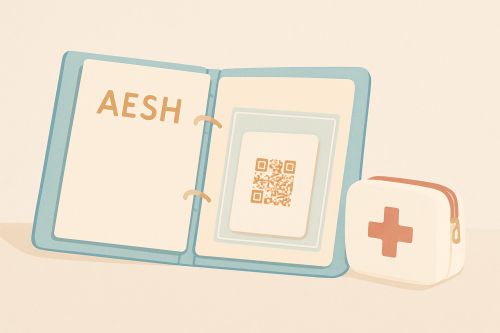
A child with epilepsy on stabilized treatment may have no seizures at all during the school year. Or maybe three. The AESH (a teaching assistant for students with disabilities, in France) needs to know what to do without having to search for a protocol in a panic. An emergency sheet in the binder, a QR on the back: what to do in eight lines, numbers to call, actions to avoid.
This case concerns children with diagnosed epilepsy, on treatment, attending mainstream school with or without AESH support, with a PAI (Individual Care Plan, a French document setting out care arrangements at school for a health condition) in place.
The moment as it happened
Cafeteria, Thursday at noon. Lena, 7 years old, is eating at the first-grade (CP) table. The AESH (a teaching assistant for students with disabilities, in France) is sitting next to her. Lena puts down her fork, she stares into space for seven or eight seconds. Her head tilts slightly to the right. Her right arm stiffens. The AESH puts her hand on Lena's table to signal the supervisor walking by, without making noise.
The seizure lasts forty seconds. The AESH notes the time on the back of her hand (1:02pm, 40 seconds, absence seizure plus stiffening of the right arm). She takes out the laminated card from the AESH binder that she always carries and scans the QR to be sure of the protocol. She checks: no recovery position needed (the child is seated, the seizure is brief), call the parents if the seizure lasts over 3 minutes or repeats within 30 minutes, call emergency services if there is prolonged loss of consciousness.
At 1:04pm, Lena comes to. She is tired but conscious. She asks for water. The AESH sends a text to the mother with the 6-line summary they had prepared together the week before.
- You write it
- The QR is in place
- The reader scans
- Understood, without explaining again
Where to place the QR for this case
A laminated card, index-card size, kept by the AESH (a teaching assistant for students with disabilities, in France) in her binder (transparent pocket), with the QR on the back and a clear emergency reminder on the front: the child's name, usual seizure type, average duration, threshold for calling emergency services, parent contacts.
Duplicate it in the classroom notebook hung on the child's hook, in the spare clothes bag, and at the school infirmary. For school outings, the card travels with the teacher's bag in a clear card holder.
Avoid a badge worn around the neck: cumbersome, forgotten, taken off by the child. Avoid the parents' wallet: they are not on site when the seizure starts.
Here, the QR is the layer of detail (full protocol, seizure history, medication contraindications). The front stays readable without a scan, for immediate action. This redundancy saves time.
Pre-written text templates
The three templates below are written from the parent's side, validated by the neurologist if possible. Medical vocabulary is present but always followed by a concrete action.
For the "Presentation" section
"Lena is 7 years old, in second grade (CE1). She has generalized epilepsy diagnosed at age 4, on daily treatment (Depakine). Her last seizure was 8 months ago. Her typical seizures: absence seizures of 30 to 60 seconds, sometimes with stiffening of the right arm. She comes to on her own without prolonged confusion."
For the "How to help" section
"You can: time the seizure, place her in the recovery position if she is lying down and unconscious, protect her head, call the parents. After the seizure: let her rest calmly for 15 to 20 minutes, offer her water, don't ask her anything for 5 minutes."
For the "What to avoid" section
"To avoid: putting anything in her mouth (this risks choking), holding her still by force during the seizure, startling her or calling out loudly to her at the end, forgetting to note the time and duration, forgetting to let us know even if the seizure is brief. Every seizure matters for the doctor."
Disabilities and conditions this case applies to
This case starts from generalized epilepsy on treatment. It also concerns partial (focal) epilepsy and West syndrome in very young children, with different protocols detailed case by case on the QR sheet.
Similar cases
Three other cases where the QR supplements an official PAI (Individual Care Plan, a French document setting out care arrangements at school for a health condition) with an operational reminder accessible in ten seconds.
The AESH has access from day one to the strategies that work (visual timer, breaks, breaking tasks down) without waiting for the first schoo…
View the case Student with autism (level 2 ASD), age 10 Reader: Substitute AESHThe substitute AESH identifies the sensory triggers, routines, and warning signs of a meltdown, and avoids making an overload worse by disco…
View the case Student with dyspraxia in year 7, age 11 Reader: AESHThe AESH knows when to help technically (formatting, breaking down instructions) and when to let the student work things out alone, without …
View the caseNo need to explain it to every new person.
Three texts (introduction, how to help, what to avoid), one shared QR code. When they scan it, the person reads what they need to know, in their own language.