






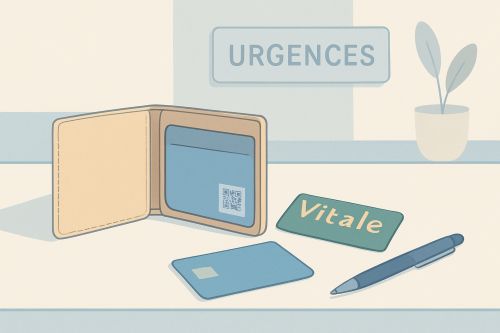
Let the doctor or emergency responder know that you understand everything, even when the words will not come out
A laminated card in the wallet, and the doctor, the emergency physician or the pharmacist understands that you take everything in, even when the words do not come out the way you would like. No patronising looks, no decisions made on your behalf.
This case is about an adult with aphasia following a stroke, whose comprehension of language is preserved but who struggles to find their words, and their spouse who wants to make every encounter with a new healthcare professional easier.
The moment lived
Monday morning, the waiting room of an emergency physician you have never seen. Your spouse is with you. On arrival, the doctor starts by asking your spouse the questions, over your head, as if you were not there.
You hand over your laminated card. The doctor scans it. He reads within thirty seconds: "Post-stroke aphasia. I understand everything you say to me. My answers may be slow or halting, but they are my own. Speak to me directly, not to my spouse."
The doctor corrects himself, addresses you. He gives you time to put things into words. Your spouse steps in only if you ask. The consultation goes differently. You leave with the feeling of having been treated as a capable adult.
- You write it
- The QR is in place
- The reader scans
- Understood, without explaining again
Where to place the QR code for this case
The goal: that the card is presented straight away at every new medical or administrative interaction, to frame the communication from the first second.
- A laminated bank-card sized card in the wallet, in front of the other cards.
- An identical card in the phone case, to show a healthcare professional if the wallet is in another pocket.
- A QR label stuck on the back of the health insurance card, presented routinely at consultations.
- A folder with the current prescriptions, for recurring medical appointments.
The rule: present the card BEFORE the person starts talking to whoever is with you.
Pre-written text templates
Three outlines to frame communication with a healthcare professional who is not familiar with your situation.
For the "About" section
"I am [first name]. I had a stroke in [date]. Since then, I have lived with aphasia: my comprehension is intact, but finding my words takes time. My spouse can help me, but it is me you should be talking to."
For the "How to help" section
"What helps: looking at me directly, speaking to me at a normal pace (not too slow, I am an adult), giving me time to answer without finishing my sentences, accepting a halting answer, letting me point to a picture or write if needed."
For the "What to avoid" section
"What to avoid: talking to me as if I were a child or someone who does not understand, addressing my spouse while ignoring me, finishing my sentences for me, raising your voice because I am slow, assuming that I do not grasp the medical situation."
Conditions covered
Aphasia is central here. It most often occurs after a stroke, but can also come with other brain injuries.
Similar cases
Three other situations where a wallet card sets out from the start how the person in front should speak to you.
The other person understands the situation right away and adapts how they communicate, without the person having to explain what they can no…
View the case Older adult with Alzheimer's, 78 years old Reader: Passerby, policeIn case of wandering or disorientation, someone can access the emergency information and the family's contacts.
View the case Adult with a cognitive disability, 22 years old Reader: Anyone they turn to when they're stuckThe person can get help without having to explain out loud what they cannot put into words.
View the case