


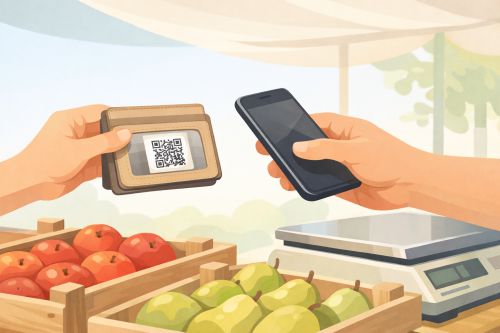
Two kilos of apples, a punnet of strawberries, and coins spread across the stall: the card slipped into his wallet teaches the greengrocer to count with Adam, not for him
A card tucked into the wallet, right in front of the coins, read by the greengrocer the first time Adam pays, and the moment of the change stops being a race: the price said slowly, shown on the scale, the coins counted together in his palm.
This case is about Adam, 26, who has Down syndrome and does his Saturday shopping on his own at his local market. The profile was prepared by his sister Céline. It is meant for market traders, greengrocers, cheesemongers, fishmongers, and anyone who hands back change quickly with a queue behind.
The moment itself
Saturday, 10:15 am, the market on Place Carnot. Three people are waiting behind Adam, shopping trolleys in hand. The greengrocer weighs the apples, calls out "four seventy" over the noise of the crates and is already holding out his hand. Adam opens his wallet, takes out a ten-euro note, puts it back, takes out some coins. A woman sighs. His question, "how much is it?", comes out too quietly. Nobody hears it.
Céline has slipped a card in front of the coins. The greengrocer notices it and scans it between two customers. He reads that Adam understands everything and knows how to pay, that he needs the price said slowly, or shown, and a little time to count. Rushing him makes him drop everything on the stall.
The following Saturday, the greengrocer turns the scale display towards him. "Four euros seventy." He waits. Adam puts down a five-euro note. The change comes coin by coin, out loud, into his open hand. Twenty more seconds for the queue. Adam leaves saying "see you Saturday".
- You write it
- The QR is in place
- The reader scans
- Understood, without explaining again
Where to place the QR code for this case
At the market, everything happens at the moment of paying, in a few seconds, with hands full. The QR code has to appear where the trader is already looking: the hand holding out the money.
- A card slipped into the clear window of the wallet, on the coin side, visible as soon as it opens. The trader sees it without Adam having to take it out or explain himself.
- A laminated copy hooked onto the handle of the shopping trolley, for the seller serving from the other side of the stall who cannot see the wallet.
- The link sent once by Céline to the two or three regular traders, during a visit to the market together. Those ones will have read the profile before the next Saturday.
- To rule out: the phone case, which Adam keeps in his inside pocket for fear of losing it in the crowd, and the shopping list, crumpled and then forgotten on a stall by the end of the morning.
Nothing on the card says why it is there. One QR code, one sentence: "Scan me, ten seconds is enough". If the greengrocer taps on Down syndrome, the explanation that opens speaks to him as a trader, not as a support worker. Céline updates the myHandiQR profile whenever she likes, without reprinting the card.
Pre-written text templates
These drafts are a starting point for the three sections of the profile. Rewrite them with what you see day to day: the way your brother, your son or you yourself handle money, noise, crowds. A trader reads between two customers. Simple sentences work better than long explanations.
For the "Introduction" section
"I am Adam's sister. He is 26 and has Down syndrome. He lives in a supported flat and does his shopping on his own on Saturdays. He knows what he wants to buy and understands what people say to him. Counting change quickly, with people waiting behind, puts him in difficulty."
For the "How to help" section
"Say the price slowly, or show it on the scale. Give him time to get his money out. Count the change out loud as you place it in his hand. If he speaks too quietly, ask him to repeat, he is happy to. A 'see you Saturday' makes him smile."
For the "What to avoid" section
"Don't take the money out of his wallet yourself, even to help. Don't talk about him to the person behind. Don't finish his sentences. Don't rush him: he puts everything away and leaves without his fruit."
Conditions covered by this case
This case starts from Down syndrome in an adult who does his shopping on his own. The same card works for a person who counts slowly, an autistic adult thrown off by the noise of the market, or someone whose anxiety rises as soon as a queue forms.
Similar cases
Other everyday shopping and local situations where a well-placed card saves explaining everything again, at the checkout, at the hairdresser or at the counter, for customers of all ages.
The other person understands the situation right away and adapts how they communicate, without the person having to explain what they can no…
View the case Older adult with Alzheimer's, 78 years old Reader: Passerby, policeIn case of wandering or disorientation, someone can access the emergency information and the family's contacts.
View the case Adult with a cognitive disability, 22 years old Reader: Anyone they turn to when they're stuckThe person can get help without having to explain out loud what they cannot put into words.
View the caseNo need to explain it to every new person.
Three texts (introduction, how to help, what to avoid), one shared QR code. When they scan it, the person reads what they need to know, in their own language.