


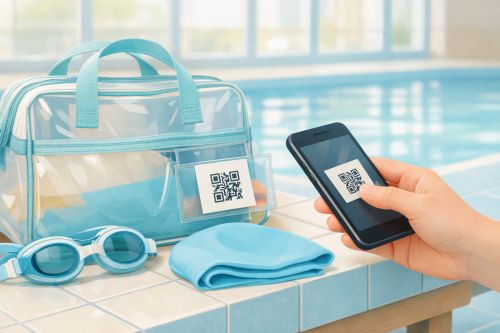
A water confidence test and arms that won't keep up: the card in the swim bag teaches the lifeguard to show the movement rather than shout it
A laminated card handed over at the edge of the pool, read by the lifeguard before the first whistle, and the water confidence test becomes what it should be again: a safety check, not a coordination exam judged by shouting.
This case is about Éloïse, 11, in her last year of primary school, who has dyspraxia. She can swim and she is not afraid of water, but putting movements together in the right order takes an effort the others don't see. The profile was prepared by her mother, Céline. It is meant for lifeguards and swimming instructors at public pools.
The moment itself
Wednesday, 2:10 pm, the local public pool. The air is heavy with chlorine, and the noise bounces off the tiles: shouts from the shallow end, ventilation, a whistle in the distance. Today Éloïse is taking the water confidence test required for the school sea trip in June. She spent twenty minutes in the changing room. Her cap slipped off twice, and her goggles stayed upside down on her forehead.
At the edge of the deep end, Marc, the lifeguard, holds the sign-up sheet on his clipboard. Céline hands him a laminated card taken from the bag's pocket. He scans it and reads while the two other children do their jump. "Okay. I show you, you do it." He no longer says "right arm". He raises his own.
The jump, floating on her back, swimming under the lane rope, the twenty metres on her front. Her stroke is choppy, her head comes up too high, her legs scissor out. Marc doesn't blow the whistle. He walks along the pool at her level and waits until she touches the wall. Certificate signed at 2:32 pm. Éloïse comes out without crying, which hadn't happened to her at the pool since she was eight.
- You write it
- The QR is in place
- The reader scans
- Understood, without explaining again
Where to place the QR for this case
At the pool, you can't wear anything on you at the edge of the water. The QR has to travel in whatever goes from the changing room to the poolside, or be handed over before the child gets in.
- A laminated card slipped into the clear pocket of the swim bag. Céline, or the leader from the holiday club, hands it to the lifeguard at roll call, when he checks his list.
- A sticker inside the goggles case. On days when Éloïse comes with the holiday club, the leader knows where to find it without rummaging through the bag.
- A copy stapled to the sign-up form for the test or for the school swimming lessons, so the instructor has it in front of them before the session.
- To avoid: the locker wristband, which stays on in the water and that nobody thinks to scan, and the phone, which is banned on the poolside in most facilities.
The card doesn't talk about swimming. One line is enough: "Show me the movement, I understand better than when it's said out loud". If Marc taps on dyspraxia, the explanation that opens speaks to him as a sports instructor, with practical pointers for the poolside. Céline updates the myHandiQR profile when Éloïse joins the swimming club, without making a new card.
Pre-written text templates
Three short texts, written by Céline with Éloïse one homework evening. They can be read in under a minute on a phone held in one hand, leaving the other free for the whistle. The tone stays that of an 11-year-old girl who mostly wants to be left to swim.
For the "Introduction" section
"I am Éloïse's mum. She is 11. She has dyspraxia: she can swim and isn't afraid of water, but coordinating her arms, legs and breathing takes a lot of effort. She is slower, not in danger. The changing room already tires her out."
For the "How to help" section
"Show the movement rather than saying right or left. Give one instruction at a time, then wait until she has done it. Walk alongside her at the edge of the pool. A thumbs up at the end of a length is enough to get her going again."
For the "What to avoid" section
"Shouting instructions from the other end of the pool: with the echo, she can't understand them. Comparing her to the other children. Stopping her length with the whistle if she isn't in trouble. Rushing her in the changing room in front of the group."
Conditions covered by this case
This case concerns dyspraxia, which affects planning and sequencing movements. The same approach works for a child with ADHD who loses track of spoken instructions, sensitivity to noise in an indoor pool, or anxiety that rises as soon as they feel watched.
Similar cases
A guided museum visit, a cinema outing, a birthday party at a friend's house: other leisure activities where a few seconds of reading keep slowness from being mistaken for refusal or fear.
The youth worker includes the child in group games by anticipating risky moments (transitions, waiting times), without punishing restlessnes…
View the case Teen with social anxiety at summer camp, age 12 Reader: Summer camp director, activity leaderThe camp staff identify risky moments (large groups, noisy evening activities) and offer discreet ways to step back without stigmatizing the…
View the case Deaf child in a sports club, age 9 Reader: Sports coachThe coach adjusts instructions (visual cues, gestures, signaling exercises) so the child isn't left out from missing a spoken request.
View the caseThis situation is something you should not have to replay with every new person.
Every new school year, every new substitute, every appointment: you have to start all over again. myHandiQR puts an end to that. You write it once. You will no longer start from scratch at every meeting.