


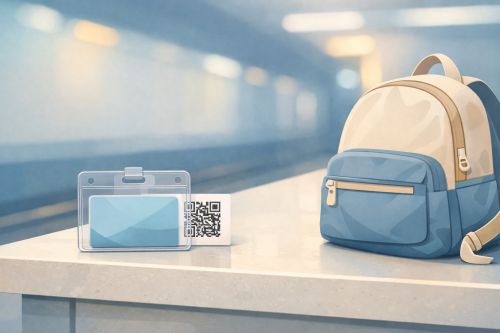
A connection at Châtelet, three signs at once and a crowd that keeps moving: the card slipped into the pass holder teaches the RATP (Paris public transport) agent to show only one path at a time
A QR code card slipped behind the transport pass, scanned by the RATP agent when a teenage girl stands still in the middle of a connecting corridor, and the guidance changes: one path, named in a calm voice, instead of three directions thrown out with a sweep of the arm.
This case is about Amina, 16, who has dyspraxia and takes the metro alone to get to school. The profile is prepared by her mother. It is meant for the station or information agent who crosses her path.
The moment as lived
5:40 pm, Châtelet station, the connecting corridor toward line 14. Signs follow one another, blue, yellow, arrows pointing every which way, and a stream of people that never stops. Amina has stopped against the wall. She knows where she is going. She does not know in which order to read what she sees, and every step in the crowd costs her a distance calculation she gets wrong. Her breathing gets short.
An agent in a vest comes over and points to the stairs with a wide gesture: "It's that way, then right, then straight ahead." Three directions in one sentence. Amina nods and does not move. She then takes her pass out of its holder. The card is there, behind it. The agent scans it with his phone and reads: she understands the route, but she cannot turn it into movements under pressure, one instruction at a time.
He starts again, more quietly: "Do you see the yellow arrow, over there? Go as far as that." She goes. Then the next one. On the platform, she finally breathes, and sends a message to her mother: "all good, a man helped me."
- You write it
- The QR is in place
- The reader scans
- Understood, without explaining again
Where to place the QR for this case
In the metro, nobody takes out a notebook or digs through a bag. The agent looks at the hands and the upper body, and at whatever is in plain view without having to ask: the transport pass, which is shown at every gate anyway.
- Card slipped behind the pass in its transparent holder, QR side visible when the whole thing is taken out, without exposing the profile to the whole carriage.
- Sticker on the back of the phone case, for the moment when she can no longer find the holder in her bag.
- Link on the phone's lock screen, reachable without unlocking, for situations where she can no longer speak.
To avoid: the QR on the backpack, which everyone sees and nobody can scan in a crowded corridor, and the card left at home in a drawer "just in case". The rule is simple: what is useful in the crowd is kept with the pass, never far from the hand.
Ready-made text templates
The templates below are a starting point for the three sections of the profile. Rewrite them in your own words: the way your teen freezes, or starts walking too fast, is theirs alone, and that detail is what makes the profile useful to an agent who crosses their path for thirty seconds.
For the "Introduction" section
"I am Amina's mother. She is 16 and has dyspraxia: she understands everything, but finding her way in space and handling several landmarks at once takes a lot of effort. In a crowd or a corridor full of signs, she may stop dead, and it is not ill will."
For the "How to help" section
"Give one direction at a time, with a visible landmark: an arrow, a color, a sign. Speak calmly, without rushing her. If needed, walk her to the right platform, a few meters is enough. You can let her mother know by message, she prefers to be kept informed."
For the "What to avoid" section
"Avoid giving her the whole route at once, or repeating it faster and louder. Avoid taking her arm without warning. Avoid rushing her in the crowd, it makes the freeze worse. Avoid leaving her alone at the foot of a staircase if she hesitates."
Conditions covered by this case
Dyspraxia is at the heart of this case, with the anxiety that comes with it in overcrowded places. The same welcoming gestures also help travelers with an attention disorder, sensory hypersensitivity or the beginning of disorientation.
Similar cases
Other situations involving travel, counters or reception, where a professional crosses paths with a person for thirty seconds and has to understand quickly.
The other person understands the situation right away and adapts how they communicate, without the person having to explain what they can no…
View the case Older adult with Alzheimer's, 78 years old Reader: Passerby, policeIn case of wandering or disorientation, someone can access the emergency information and the family's contacts.
View the case Adult with a cognitive disability, 22 years old Reader: Anyone they turn to when they're stuckThe person can get help without having to explain out loud what they cannot put into words.
View the case