


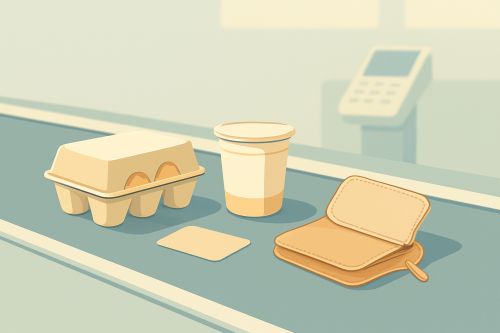
The items keep coming, the queue keeps growing: the card slipped into the loyalty card sleeve tells the cashier why Céline packs and pays slowly
A card placed on the belt with the first item, read by the cashier before the first scan, and the pace changes: there is time to bag, to take out the bank card, to type the PIN, with no sighing and no advice.
This case is about a 33-year-old woman with dyspraxia who shops on her own. She wrote the profile herself, and it is addressed to the person at the till, someone she will probably never see again.
The moment as it happens
Saturday, 11:40, till 6. The belt moves, items pile up at the end, and the cashier scans faster than Céline can bag. A pot of yogurts, a bottle of oil, a box of eggs: she grabs, misses, grabs again. Behind her, a full trolley, a man looking at his watch. Her hand searches for the bank card in her bag, finds the keyring, then a crumpled receipt.
Before emptying her basket, she put a ticket-sized card on the belt. Sandrine, according to her badge, reads it between two items. Céline has dyspraxia: she knows exactly what to do, but her movements take time and attention, especially when she is being watched. She only asks that nobody comments on how slow she is.
Sandrine slows the belt down. She waits until the eggs are at the bottom of the bag before starting the next items, holds out the terminal at the right height, says nothing. Céline types her PIN in one go. Nobody sighed in the queue, and she leaves without having said "sorry" even once.
- You write it
- The QR is in place
- The reader scans
- Understood, without explaining again
Where to place the QR for this case
The right spot is one the cashier can see without looking for more than a second, and that Céline can take out without rummaging. Rummaging in front of a queue is exactly what makes her stumble.
- Card slipped into the clear sleeve of the loyalty card, which she takes out anyway at the start of each checkout: it is the most practised gesture at the till.
- Sticker from an A4 sheet, stuck on the back of the phone, for self-checkouts where a staff member comes to help.
- Card placed on the belt with the first item, when the till is run by someone new to her.
A QR on the reusable bag is ruled out, it gets lost at the bottom. So is one on the trolley: the trolley belongs to nobody, and the cashier does not look at it. And nothing on the back or on the coat, because the queue has no need to read anything. The card informs one person, for a few seconds, not the whole checkout.
Ready-made text templates
The templates below are a starting point for filling in the profile sections. Rewrite them in your own words: the way you ask for time, without apologising, is what makes the profile feel right.
For the "Introduction" section
"My name is [first name], I am [age] years old and I have dyspraxia. I understand everything I am asked, but my movements are slow when I have to pack, count or type a PIN at the same time. It says nothing about how serious I am. I come to do my shopping like everyone else."
For the "How to help" section
"You can slow the belt down and wait until I have finished bagging before scanning the next items. You can hand me the terminal without holding it up in the air. If I am counting change, let me finish. A simple 'take your time' is enough for me."
For the "What to avoid" section
"Please don't pack for me without asking. Please don't sigh or look at the queue on my behalf. Please don't comment on how slow I am or advise me to get organised differently. Please don't speak louder: I understand."
Conditions covered by this case
Here, dyspraxia is paired with anxiety, which rises quickly when one feels watched. The same simple adjustments help people with a coordination difficulty, ADHD or a less recognised form of dyspraxia.
Similar cases
These cases share the same setting: a few minutes' exchange with a stranger, where a card read at the right moment is enough to avoid pressure.
The other person understands the situation right away and adapts how they communicate, without the person having to explain what they can no…
View the case Older adult with Alzheimer's, 78 years old Reader: Passerby, policeIn case of wandering or disorientation, someone can access the emergency information and the family's contacts.
View the case Adult with a cognitive disability, 22 years old Reader: Anyone they turn to when they're stuckThe person can get help without having to explain out loud what they cannot put into words.
View the caseThis situation is something you should not have to replay with every new person.
Every new school year, every new substitute, every appointment: you have to start all over again. myHandiQR puts an end to that. You write it once. You will no longer start from scratch at every meeting.