


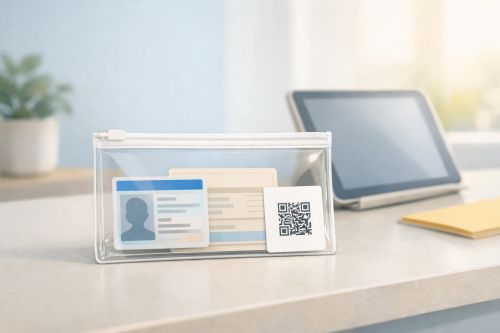
A cramped form on a tablet, a contract to sign at the counter: the card slipped into the registration folder lets the recruitment officer know before the first assignment
A card slipped into the registration folder, read by the recruitment officer before the first assignment, and the job instructions arrive in three short sentences, spoken aloud, instead of a dense text to read while standing.
This case is about a 29-year-old temp worker with dyspraxia and dyslexia who registers with a temp agency. He prepared the profile himself, and it is aimed at the recruitment officer who welcomes him, calls him back and sends him his assignments.
The moment as lived
Tuesday, 8:40 a.m., the temp agency in the retail park. Ilyes, 29, fills in the registration form on a tablet resting on the counter. The boxes are tiny, the fields overlap, the cursor jumps from one line to another. It drags on. Behind him, two people are waiting, and Nadia, the recruitment officer, glances at the screen, wondering whether he has understood the instructions.
In his plastic folder, between his ID and his bank details, there is a card with a QR code. Nadia scans it at the end of the interview. She reads that Ilyes has dyspraxia and dyslexia, that he reads a dense text slowly but remembers very well what he is told, that cramped forms are hard for him, and that he is fast and careful at order picking. He holds the RQTH (official recognition of disability status for work, in France), and only mentions it to those who need to know.
The next day, the assignment arrives by text message, three lines: address, time, name of the team leader. The contract is read through with him, point by point, then signed without rushing. Nadia did not write "slow" in the file. She noted: short, spoken instructions.
- You write it
- The QR is in place
- The reader scans
- Understood, without explaining again
Where to place the QR for this case
The QR code should be right in front of the recruitment officer when she opens the file, before she hands over a form to fill in or a contract to sign. It should not be left where everyone can see it.
- Card in bank-card format, slipped into the plastic folder holding the registration papers (ID, bank details, social security certificate), handed to the agency when the file is opened.
- Link sent by email or text message to the recruitment officer after the first meeting, so that it stays attached to the file even when another agent takes over.
- Card handed in person to the team leader on the first day of the assignment, together with the temporary placement contract.
To avoid: the company badge or the vest, seen by all colleagues, and the phone case, which nobody scans at the counter. The right approach is discreet: the agency is informed, and the client company's team does not have to be, in front of everyone.
Ready-made text templates
The templates below are a starting point for filling in the profile sections. Make them your own: the way you read a contract or handle a form is yours, and that detail is what makes the profile useful to the agency.
For the "Introduction" section
"My name is [first name], I am [age], and I am looking for logistics assignments. I have dyspraxia and dyslexia. I read dense text slowly and filling in a cramped form takes me time, but I remember very well what I am told and I work carefully."
For the "How to help" section
"Give me assignment instructions out loud, in three points: address, time, contact person. Go through the contract with me before I sign. If I have a form to fill in, give me a moment or help me with the writing part. A short text message is better than a long email."
For the "What to avoid" section
"Please do not hand me a dense paper and ask me to sign on the spot. Do not make me fill in a form standing in a queue. Do not mistake my slow reading for a lack of motivation: it says nothing about my work."
Disabilities covered by this case
This case is first about dyspraxia and dyslexia. It also applies to other ways of working where writing and forms are hard, such as dysgraphia or ADHD, and to anyone who works well orally.
Similar cases
Other job situations, from the visit to the occupational physician to the appointment with the France Travail adviser, rely on the same idea: let people know before starting.
The recruiter adjusts her questions (less unspoken meaning, no trick scenarios) and correctly interprets the lack of eye contact, without co…
View the case Employee with ADHD during onboarding, age 34 Reader: Direct managerThe manager structures interactions (short, frequent check ins, written instructions, visible priorities) so the employee's forgetfulness is…
View the case Employee with generalized anxiety, age 28 Reader: HR director, disability officerThe HR director grants some remote work and an adjustment to the open space setup, so the employee doesn't have to describe her anxiety out …
View the casePrepare your profile for this situation, without having to explain it again every school year.
You write down the essentials once. The grading teacher, the AESH (a teaching assistant for students with disabilities, in France), the substitute scan and understand. You stop repeating yourself.