


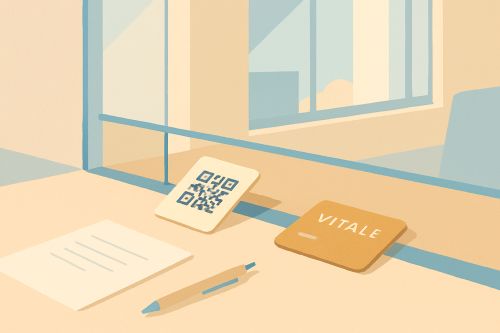
At the CPAM counter (the French health insurance office), the words won’t come: the card slipped in with the Carte Vitale tells the clerk they can switch to writing
A card slipped between the Carte Vitale and the certificate, handed to the counter clerk, and Éloïse’s silence stops being taken for a refusal: the clerk picks up a pen, turns the screen around, and the file moves forward without her having to say a word.
This case concerns a 27-year-old woman whose speech blocks in front of a stranger, especially in a public place with a queue waiting behind her. The profile is prepared by herself, and it is addressed to the reception clerk of a CPAM office, who handles dozens of requests a day.
The moment as it happens
Tuesday, 9:40 a.m., downtown CPAM office, ticket B 112 in hand. The screen shows counter 4. Éloïse steps forward, puts her Carte Vitale on the counter, opens her mouth. Nothing comes out. She had rehearsed it on the tram: change of bank details, reimbursements that have stopped arriving for two months. Behind her the queue grows, a phone rings, the glass amplifies the voices. The clerk, Patrick, repeats his question a tone louder, then a tone lower, then looks at the clock.
She then takes a small QR code card from the sleeve of her Carte Vitale and pushes it under the glass. Patrick scans it. He reads a few sentences from Éloïse: she hears very well, she understands everything, but her voice closes up in front of a stranger, even more so under pressure. What helps is a pen and a sheet of paper, or a screen turned towards her, and questions that can be answered with yes or no. What to avoid is repeating, waiting while staring at her, or telling her to relax.
Patrick slides a sheet and a pen through the opening and turns the input screen around. Éloïse writes the old bank details, ticks the reason, points to the line on the form. The questions boil down to one: is it the account closed in January? She nods. Eleven minutes later, the request is registered and the receipt printed. The queue waited no longer than on an ordinary Tuesday. Éloïse puts the card back in the sleeve, in its place, before leaving.
- You write it
- The QR is in place
- The reader scans
- Understood, without explaining again
Where to place the QR for this case
At the CPAM counter, everything is decided in the first seconds, when the clerk has already asked their question and the queue is watching. The QR should therefore travel with the document the clerk asks for first, the Carte Vitale, and not in a bag that would have to be searched in front of everyone.
- Card in bank card format, slipped into the Carte Vitale sleeve: it is handed over with the card, with no extra gesture and no word to say.
- Sticker on the back of the entitlement certificate or the document folder, for days when you come with a paper file.
- Screenshot of the QR saved as a favorite on the phone, for when you simply show the screen to the clerk.
- To avoid: the QR stuck on the Carte Vitale itself, which must stay intact and readable by the reader, and a badge worn around the neck, which points at the person rather than the exchange.
The idea is to give the clerk a simple gesture, scan then read, without the person having to justify themselves out loud in front of the next counter. If the office works by appointment, the link can also be sent by message before the visit.
Ready-made text templates
The outlines below are a starting point for filling in the profile sections. Rework them in your own words: the way your silence shows up and what makes it ease belong to you, and that detail is what makes the profile useful to the clerk. The profile is created on myHandiQR and can be edited at any time.
For the “Introduction” section
“My name is [first name], I am [age] years old. I have selective mutism: in front of a stranger, especially in public, my voice blocks, even though I hear and understand everything. It is neither shyness nor contempt. I am here for a specific procedure, and I can complete it in writing.”
For the “How to help” section
“Pass me a pen and a sheet of paper, or turn the screen towards me. Ask closed questions that I can answer with a gesture, yes or no. Give me time to get started, without staring at me. If the procedure needs a longer exchange, offer me an appointment or a contact by email.”
For the “What to avoid” section
“Do not repeat the question louder. Do not fill my silences for me and do not conclude that I am refusing. Do not ask me to relax or to make an effort. Avoid commenting in front of the queue: I can hear you very well.”
Conditions covered by this case
Selective mutism is the main entry, along with the social anxiety that often accompanies it. The same adjustments (writing, closed questions, time given) also help people with aphasia, people who stutter, or people overwhelmed by the stress of a counter.
Similar cases
The cases below share the same mechanics: a clerk discovers the person in ten seconds, with no handover, and the way they open the exchange decides what happens next in the procedure.
The other person understands the situation right away and adapts how they communicate, without the person having to explain what they can no…
View the case Older adult with Alzheimer's, 78 years old Reader: Passerby, policeIn case of wandering or disorientation, someone can access the emergency information and the family's contacts.
View the case Adult with a cognitive disability, 22 years old Reader: Anyone they turn to when they're stuckThe person can get help without having to explain out loud what they cannot put into words.
View the case