


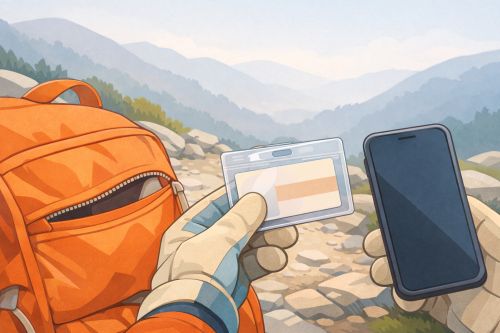
Fog, a twisted ankle, helmets and loud voices: the card taken out of the backpack tells the PGHM rescuer (French mountain gendarmerie) to say his first name before laying a hand on him
A laminated card in the zipped pocket of the backpack, taken out by the PGHM rescuer (French mountain gendarmerie) as soon as he kneels beside Matteo, and the evacuation begins with a first name and short sentences, not with hands laid on without warning.
This case is about a 24-year-old young adult with Down syndrome who hikes with his family or his group. The profile is prepared by a parent and is aimed at mountain rescuers, who have little time and rarely a network signal.
The moment as it was lived
4:40 pm, above the mountain hut, the fog came down in twenty minutes. Matteo, 24, slipped on a wet slab and his ankle will no longer carry him. Sitting among the stones, he no longer answers his uncle. When the helicopter lands further down and two PGHM gendarmes climb up, he hugs his bag against him and stares at his shoes. The helmets, the loud voices, the rescue blanket flapping: everything arrives at once. The rescuer asks his name, his pain, what he has eaten. Silence.
Gaëtan opens the zipped pocket the uncle points to: "He has a card." He scans it. He reads what Matteo's mother wrote. Short sentences, one idea at a time. He freezes when he is rushed or when people talk about him over his head. He says yes to everything when he is afraid, even when he is in pain. You have to say what you are going to do before doing it, and have him point to the pain with a finger instead of asking where it hurts.
Gaëtan crouches down to his level, says "Matteo", and announces: "I'm looking at your ankle. I'm touching it gently." Matteo points. The splint goes on, the stretcher is prepared, and during the helicopter winching the uncle stays in his field of vision, as the profile asks. On arrival, the SAMU doctor (French emergency medical service) receives the message in two sentences, without anyone having to recount the day.
- You write it
- The QR is in place
- The reader scans
- Understood, without explaining again
Where to place the QR code for this case
In the mountains, the QR code has to survive rain, cold and falls, and be found by someone wearing thick gloves who has thirty seconds. It must also be readable when the network signal is weak: always keep a paper version of the three essential lines.
- Laminated card in the high zipped pocket of the backpack, always the same from one outing to the next, which the group leaders know by heart.
- Sewn-in label inside the collar of the jacket, because the backpack may stay on the trail while Matteo is evacuated.
- Silicone bracelet on the wrist for summer outings, when the jacket stays at the bottom of the bag.
- Three handwritten lines on the back of the card (first name, "short sentences", the parent's number), readable without a network or a charged phone.
To avoid: the outer pocket of the backpack, which opens or tears off in a slide, the phone case, whose battery gives out in the cold, and plain paper that turns to pulp in the rain. Warning the hut keeper the day before, with the link, completes the setup, since the rescue team often goes through him to reach the family. The QR code informs the rescuer, it does not label Matteo in front of the rest of the group.
Ready-made text templates
Three outlines to fill in the profile sections. Rewrite them in your own words: the way your child reacts when afraid is what makes the profile useful to a rescuer who does not know him.
For the "Introduction" section
"I am Matteo's mother. He is 24 and has Down syndrome. He has been hiking since his teens. He understands short sentences and gestures that are shown to him. Under stress, he freezes, stops answering or says yes to everything, even when something is wrong."
For the "How to help" section
"Say his first name before every sentence. Announce what you are going to do before doing it: I'm looking at your ankle, I'm touching it gently. Ask him to point with a finger. Keep a trusted person in his field of vision and let him keep his bag against him for as long as possible."
For the "What to avoid" section
"No questions he will answer yes to out of reflex. Do not talk about him in the third person in front of him. Avoid sudden gestures and long explanations during the manoeuvre. Do not separate him from his companion without telling him first."
Conditions covered by this case
This case is first about Down syndrome and the anxiety that comes with it in unusual situations. The same card also helps an autistic person or a person with an intellectual disability who freezes under pressure when an unknown adult has to step in quickly.
Similar cases
Other emergency or travel situations where the adult stepping in has only a few seconds: police officers, firefighters, cabin crew. Each has its own QR code placement.
The other person understands the situation right away and adapts how they communicate, without the person having to explain what they can no…
View the case Older adult with Alzheimer's, 78 years old Reader: Passerby, policeIn case of wandering or disorientation, someone can access the emergency information and the family's contacts.
View the case Adult with a cognitive disability, 22 years old Reader: Anyone they turn to when they're stuckThe person can get help without having to explain out loud what they cannot put into words.
View the caseNo need to explain it to every new person.
Three texts (introduction, how to help, what to avoid), one shared QR code. When they scan it, the person reads what they need to know, in their own language.