






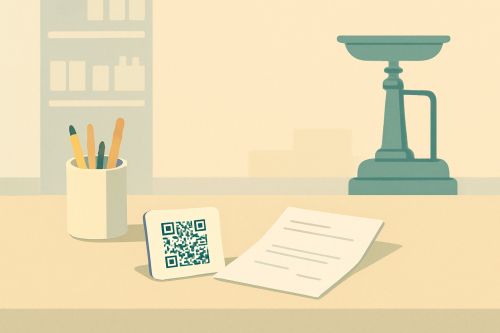
Your 82-year-old mother can no longer hear the counter, and the card tucked into her wallet asks people to write instead of shout
A card tucked into your mother's wallet, and the pharmacist, the doctor or the neighbour across the landing understands within seconds that they should write their question on a piece of paper or stand facing her, instead of repeating it a third time in a raised voice.
This case involves an 82-year-old woman with profound deafness, whose profile is prepared by her adult son or daughter, and who still does her own shopping, her own errands around the neighbourhood and her own medical appointments.
The third repetition
"Do you have your carte Vitale?" The question comes a second time, louder, then a third, almost shouted across the counter of the local pharmacy. Yvette, 82, smiles and nods, without having caught a single word. Behind her, the queue moves forward. The pharmacist quietly files her away with the confused, when in fact she simply stopped hearing voices years ago.
She opens her wallet and places on the counter a card prepared by her daughter. The QR code is scanned in a few seconds. The pharmacist reads that she lip-reads as long as people look straight at her, that a notepad and a pen settle most exchanges, and that raising your voice distorts sounds instead of making them clearer. He grabs the pad sitting next to the till, writes his question in three words, and turns the sheet towards her.
Yvette answers the first time, takes out her carte Vitale (the French health insurance card), and leaves with the right box and the dosage written in large letters on the bag. Her daughter was not called at the office to act as an interpreter, and the prescription was not brought back the next day for want of having been understood. At the counter, the exchange took the usual amount of time, and nothing suggested she was losing track.
- You write it
- The QR is in place
- The reader scans
- Understood, without explaining again
Where to put the QR code in this case
Every week Yvette meets different people, at the pharmacy, at the doctor's surgery, at the bakery, in the entrance hall of her building, and none of them has been told in advance. So the card has to come out at the same time as her health insurance card or her purse.
- A laminated card in her wallet, slipped in right in front of her health insurance card, so that it appears at the exact moment the counter asks for a document.
- A label on the back of her phone, printed from an A4 sheet of labels (standard format), useful when the wallet stays at the bottom of the bag.
- A label near the doorbell or on the letterbox, from the same A4 sheet, for the neighbour across the landing, the postal worker or the visiting nurse.
- A link sent to the doctor's surgery by her son or daughter before an appointment, so that it is on file before the first consultation.
The card has to arrive before the second repetition. After that, the exchange has already gone off on a misunderstanding, voices rise, and the person gives up asking.
Ready-made text templates
The sentences below are a starting point when preparing the profile of an elderly parent. They can be copied onto the card as they are, or rephrased in her own words, since she remains the only one who decides what goes on it.
For the "About me" section
"My name is [first name], I am [age] years old. I have profound deafness: I do not hear voices, even loud ones, and I lip-read when people face me, in a well-lit place. Writing a sentence on paper or on a screen is what works best with me."
For the "How to help" section
"You can: stand facing me before you speak, move aside anything that hides your mouth, write your question on a notepad or on your phone, show me the document you are talking about, and wait until I am looking at you before you carry on."
For the "What to avoid" section
"Please avoid: raising your voice, which distorts sounds without making them clearer, talking to me with your back turned or from another room, repeating the same sentence word for word several times in a row, speaking to the person with me rather than to me, or concluding that I have not understood the subject."
Conditions covered by this case
This case involves profound deafness, which makes speech inaudible even at a loud volume and gives visual support a decisive role. When it sets in gradually with age, the people around often mistake it for confusion or lack of interest, and that misunderstanding is the first thing the card clears up.
Similar cases
Other situations where someone stands alone in front of a person in a hurry, at a counter, at a desk or in a consulting room, and where a card taken out of a wallet says on their behalf how to speak to them.
The other person understands the situation right away and adapts how they communicate, without the person having to explain what they can no…
View the case Older adult with Alzheimer's, 78 years old Reader: Passerby, policeIn case of wandering or disorientation, someone can access the emergency information and the family's contacts.
View the case Adult with a cognitive disability, 22 years old Reader: Anyone they turn to when they're stuckThe person can get help without having to explain out loud what they cannot put into words.
View the caseThis situation is something you should not have to replay with every new person.
Every new school year, every new substitute, every appointment: you have to start all over again. myHandiQR puts an end to that. You write it once. You will no longer start from scratch at every meeting.