





High school student with DLD (dysphasia), age 15
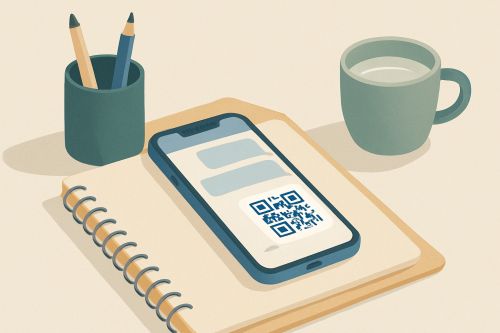
A high school student with DLD (developmental language disorder, formerly called dysphasia) speaks in choppy sentences, searches for words, sometimes reverses word order. The shared AESH (a teaching assistant for students with disabilities, in France) supporting him may, without meaning to, talk to him as if he were 8 years old. The QR shared by message with the AESH before the start of the year sets the tone: a high schooler who needs time to form his words, not simplified vocabulary.
This case concerns high school students with DLD, with a PPS (Personalized Schooling Plan, a French document defining accommodations for students with disabilities) in place, often in a vocational or technical track, with partial AESH support.
The moment as it happened
Monday morning, business class in vocational eleventh grade (1re Bac pro). The shared AESH (a teaching assistant for students with disabilities, in France) arrives, she supports three students at the school, including Maxence, 16, DLD. She sits next to him while the teacher gives instructions for the practical exercise. When Maxence starts typing, she whispers: "do you understand? do you want me to explain it again slowly?". Maxence looks up, frowns, says nothing.
At break, he opens the Signal conversation with his mother and shows her. His mother replies "look at what your AESH sent you last week". The substitute AESH hadn't read her message yet. The message she'd received to prepare contained a QR. She scans it.
She reads: "Maxence has DLD, he understands everything the teacher says, he doesn't want things rephrased at a child's level. He just wants more time to answer." She puts her phone away. After the break, she waits for him to finish reading the screen, she doesn't prompt him again.
- You write it
- The QR is in place
- The reader scans
- Understood, without explaining again
Where to place the QR for this case
For a teenager, discretion comes first. The QR shared by private message with the AESH (a teaching assistant for students with disabilities, in France) ahead of the school year is the format that preserves the student's dignity: no sticker on his backpack, no laminated card in his wallet. The information passes between the adults concerned, at the request of the person it's about.
The mother's email signature can carry a discreet link to the profile, which lets any substitute AESH contacted by phone scan it ahead of the first class. A group message on the coordination thread for the ULIS unit or the student life office (with the family's agreement) is enough to cover substitutes.
Avoid visible stickers on the backpack or planner: at 16, classmates scan out of curiosity and privacy erodes. Avoid paper sheets left on the guidance counselor's desk, often filed away without being read.
For work placements, a QR on the trainee card given by the school to the host company lets the supervisor scan it without formalizing an RQTH (official disability status recognition, in France) file.
Pre-written text templates
The three templates below are written by the high schooler himself, with support from a speech-language therapist or his mother for formatting. The vocabulary here is that of a high schooler, not a child.
For the "Presentation" section
"My name is Maxence, I'm 16, in eleventh grade, vocational track in business (1re Bac pro Gestion). I have DLD, a language disorder, diagnosed at age 5 by a speech-language therapist. I understand everything people say to me. I answer more slowly because I'm searching for my words. I prefer writing to speaking when it matters."
For the "How to help" section
"You can: give me more time to answer out loud (at least 10 seconds), let me write my answer down instead of saying it, write new technical terms on the board, give me the lesson slides in advance, pair me with a calm partner who's fine with me answering with a delay."
For the "What to avoid" section
"To avoid: rephrasing things at a child's level (I already understand), finishing my sentences for me, raising your voice when I don't answer right away, saying 'make a vocabulary effort', reading my silences as bad will, calling me stupid (it's happened, and it's wrong)."
Disabilities and conditions this case applies to
This case starts from DLD (developmental language disorder), the modern equivalent of dysphasia. It also applies to severe dyslexia persisting into high school age, with the text adjusted accordingly (writing takes up more space there, speech less).
Similar cases
Three other cases where the QR stays within the teenager's private circle, shared with those who need it, never displayed publicly.
The AESH has access from day one to the strategies that work (visual timer, breaks, breaking tasks down) without waiting for the first schoo…
View the case Student with autism (level 2 ASD), age 10 Reader: Substitute AESHThe substitute AESH identifies the sensory triggers, routines, and warning signs of a meltdown, and avoids making an overload worse by disco…
View the case Student with controlled epilepsy, age 7 Reader: AESHThe AESH knows what to do in case of a seizure (position, how long to wait before alerting others, contacts) without having to search for a …
View the case