


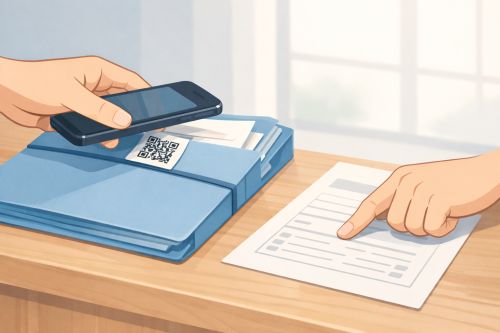
A claim to file and words that won't come: the card on the folder teaches the court clerk to wait for Sofiane, not to finish his sentences
A card tucked under the elastic band of the folder, read by the clerk before the very first question, and filing a claim at the employment tribunal becomes an ordinary errand again: yes or no questions, time to answer, a finger placed on the right box of the form.
This case is about Sofiane, 41, who has lived with aphasia since a stroke two years ago. He understands what people say to him, but the words get stuck as soon as he has to speak quickly. The profile was prepared by his wife, Amina. It is aimed at court clerks and reception staff in courts.
The moment itself
Tuesday, 9:40 am, the employment tribunal (conseil de prud'hommes, in France). The hall smells of vending machine coffee and photocopied paper. At the clerk's counter, the queue moves slowly. Sofiane, a former forklift operator, places a blue cardboard folder on the counter, bulging with pay slips, a dismissal letter and a claim form filled in with pencil, then gone over in pen.
The clerk asks what he has come for. He opens his mouth. "Dé... le..." Nothing more. He taps the folder, blushes, tries again. Behind him, someone sighs. Under the elastic band, a card: a QR code and one sentence. Laure, a court clerk for eleven years, scans it with her phone. She reads what Amina wrote: Sofiane has had difficulty speaking since his stroke, he understands perfectly, he answers very well with yes or no. And he points.
She changes her approach. You've come to file a claim? Yes. Against your former employer? Yes. She turns the form towards him and puts her finger on it, box by box. He takes out the documents one by one, in order. Twelve minutes later, he leaves with his receipt and the date of his hearing before the conciliation panel, written in large letters on a sticky note stuck to the folder.
- You write it
- The QR is in place
- The reader scans
- Understood, without explaining again
Where to place the QR code for this case
At the clerk's office, the QR code needs to be seen when the file changes hands, on the counter. There is no need to wear it: it travels with the papers.
- A card tucked under the elastic band of the folder, on the front. It is the first thing the clerk sees when Sofiane puts down his documents, before he has to say a word.
- A spare in the wallet, behind the ID card. ID is often requested at the counter: the QR code comes out with it.
- A copy attached to the file on the day of the conciliation hearing, so that the panel members and the hearing clerk have the same information in front of them.
- To avoid: the phone screen, which Sofiane finds hard to unlock and scroll when he is under pressure, and a badge around the neck, which he finds too conspicuous in a courthouse.
The card says nothing about the stroke. One QR code, one sentence: "I understand everything, just give me a little time". If the clerk clicks on aphasia, the explanation that opens speaks to her as a reception professional, with concrete actions. Amina updates the myHandiQR profile as the case moves forward, without changing the card.
Pre-written text templates
Three short texts, written by Amina with Sofiane and read aloud together. They fit on a phone screen and can be read in under a minute, even with a queue behind. You can reuse them and adjust them to your own situation, at court, at the town hall or at any counter.
For the "Introduction" section
"I am Sofiane's wife. He is 41. Since a stroke two years ago, he has aphasia: he understands everything you say to him, but the words get stuck, especially when he is rushed or tired. He handles his paperwork on his own and knows exactly why he is here."
For the "How to help" section
"Ask one question at a time, preferably a yes or no one: he answers very well with yes or no. Give him time, even ten seconds of silence. Show him the document and the box concerned, he will point. Write the dates and the next step on a piece of paper he can keep."
For the "What to avoid" section
"Don't finish his sentences for him and don't speak louder: his hearing is fine. Don't talk to the person with him, if there is one. Don't ask him to explain everything, the documents are in the file."
Conditions covered by this case
This case concerns aphasia, which affects speech after a stroke or a head injury. The same approach works whenever words get stuck while understanding is not affected: selective mutism in adulthood, a marked stammer, language difficulties present since childhood.
Similar cases
The prefecture counter, an appointment at the CAF (the French family benefits office), signing at the notary's: other errands where a few seconds of reading save having to explain everything in front of a queue.
The other person understands the situation right away and adapts how they communicate, without the person having to explain what they can no…
View the case Older adult with Alzheimer's, 78 years old Reader: Passerby, policeIn case of wandering or disorientation, someone can access the emergency information and the family's contacts.
View the case Adult with a cognitive disability, 22 years old Reader: Anyone they turn to when they're stuckThe person can get help without having to explain out loud what they cannot put into words.
View the casePrepare your profile for this situation, without having to explain it again every school year.
You write down the essentials once. The grading teacher, the AESH (a teaching assistant for students with disabilities, in France), the substitute scan and understand. You stop repeating yourself.