






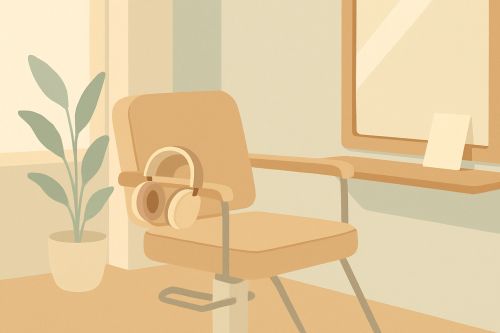
The roaring hair dryer, the scissors near his ear: the card handed in at the salon teaches the hairdresser to announce every move to Ilyes before making it
A card handed in at the salon when the parent books the appointment, read by the hairdresser before the child climbs into the chair, and the haircut starts with the right question: what do I show him first?
This case is about Ilyes, 7, who is autistic and very sensitive to noise and touch. The profile is written by his parent, for a neighborhood craftsperson who does not know him and has half an hour.
The moment as lived
Saturday, ten o'clock, the salon on Rue des Tilleuls. Three chairs, a hair dryer running at full blast at the back, the radio, water running at the basin. Ilyes has stopped on the threshold, hands pressed over his ears. His father did not have time to say a word: there are two failed haircuts behind them, one of which ended with clippers in the car.
This morning, the father gave the card to the hairdresser at the counter. She scanned it between two clients. She read that noise is the first obstacle, that the nape and the ears are areas where he cannot stand being brushed, and that he calms down when he knows what is going to happen, in order.
She turns off the radio, switches off the hair dryer, and shows him the cape and the comb on the tray before bringing them closer. She says: first the comb, then the scissors, I'll tell you. Ilyes sits down. Eighteen minutes later it is over, and he asks if they can come back.
- You write it
- The QR is in place
- The reader scans
- Understood, without explaining again
Where to place the QR for this case
A hairdresser does not have free hands and does not remember a message sent three days earlier. The QR must be read before the child sits down, and stay visible during the haircut for the colleague who might take over.
- Card handed over in person at the counter on arrival, or slipped into the pocket of the cutting cape when the salon lends one.
- Link sent by text message when booking, for salons that work with a reservation app.
- Card placed against the mirror at the station, at the hairdresser's eye level, for the duration of the haircut.
- Sticker on the salon's loyalty card, for later visits, when the team changes.
To avoid: the QR stuck on the child's back or clothing, visible to the whole waiting room, and the message left on the phone line while the salon is packed. The rule here is to give it to the professional, not to the child. To prepare the profile, a myHandiQR profile is all you need.
Ready-made text templates
The templates below are a starting point for filling in the profile sections. They can be rewritten in your own words: the way your child shows that it is too much is a detail only you know.
For the "Introduction" section
"I'm Ilyes's dad, he's 7. He is autistic and very sensitive to loud noises and unexpected touch. He understands everything and speaks little when he is stressed. He likes to know in advance what is going to happen."
For the "How to help" section
"Turn off the hair dryer and the radio before he comes in. Show him each tool before bringing it close and announce the order of the steps. Go in small stages and let him keep his noise-canceling headphones. If his hands go up to his ears, take a break."
For the "What to avoid" section
"Do not touch his nape or his ears without warning. Do not cut his hair while another machine is running. Do not ask him to stay still by holding him. Do not talk about him out loud in front of him as if he could not hear."
Conditions covered by this case
This case applies first of all to autism and sensory hypersensitivity. It also works for other particularities that make close-contact care difficult: anxiety, ADHD, any child who struggles with noise or contact.
Similar cases
The cases below share the same mechanism: a local professional, with no prior handover, understands within seconds how to welcome the person.
The other person understands the situation right away and adapts how they communicate, without the person having to explain what they can no…
View the case Older adult with Alzheimer's, 78 years old Reader: Passerby, policeIn case of wandering or disorientation, someone can access the emergency information and the family's contacts.
View the case Adult with a cognitive disability, 22 years old Reader: Anyone they turn to when they're stuckThe person can get help without having to explain out loud what they cannot put into words.
View the caseNo need to explain it to every new person.
Three texts (introduction, how to help, what to avoid), one shared QR code. When they scan it, the person reads what they need to know, in their own language.