




During a panic attack in public, the card in the wallet tells the passer-by to sit down beside you and lower their voice, without rushing anything
A card in the back pocket of a pair of jeans, held out without a word as the attack builds, and the person who stopped knows to sit down beside you, speak quietly and wait, instead of dialling 18 (the fire and rescue service in France) or gathering a crowd around you.
This case involves a 31-year-old adult who has severe panic attacks and who prepares his own profile. It is aimed at the people he crosses paths with in a public place, on a platform, in a queue, or at the colleague who happens to be there that day.
On the platform, before the train
The RER (the Paris commuter train) is announced fifteen minutes late, and the platform fills up. Camille, 31, feels the ground turn unsteady, her heart pounding too fast, her hands tingling. She knows what comes next: the feeling of suffocating, the absurd certainty that she is about to collapse in front of everyone. She leans against a pillar and lets herself slide down to the floor. A woman crouches in front of her. "Do you want me to call the fire brigade?" The only thing Camille manages to do is shake her head.
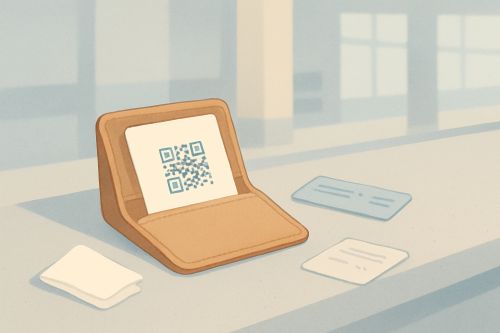
She pulls a laminated card out of her back pocket and holds it out without looking up. The woman scans the QR code. Within seconds, she reads what Camille wrote herself, one quiet evening: what is happening is a panic attack, it builds fast and then it comes back down. What helps is staying beside her without touching her, speaking softly, counting with her, making the out-breath longer than the in-breath. What makes it worse is the crowd forming, the rapid-fire questions, the siren.
The woman stands up, waves two onlookers away, comes back to sit on the edge of the platform and counts under her breath. The train pulls in. Camille gets on, still out of breath, but on her feet. Nobody formed a circle around her, nobody called the emergency services without asking her first, and she did not have to explain, between two breaths, that she was neither drunk nor having a heart attack.
- You write it
- The QR is in place
- The reader scans
- Understood, without explaining again
Where to put the QR code for this case
During an attack, fine movements become difficult and unlocking a phone can be out of reach. The QR code therefore needs to be on something the hand grabs without thinking, and that someone else can take from you if you hold it out to them.
- A laminated card in the front compartment of the wallet, the one that opens in a single movement, or straight in the back pocket of your jeans when the bag stays in the locker room.
- A label on the back of the phone case, printed from an A4 label sheet (standard template), readable even when the screen stays locked.
- A label on the company badge, from the same A4 sheet, for the colleague who finds you in the break room or in the emergency stairwell.
- A link shared with a trusted person at the office, before the first attack ever happens at work, so that they already know what to tell the others when it does.
The rule here is readability at arm's length. A QR code you have to dig for at the bottom of a bag will never be any use, because the moment it becomes useful is exactly the moment when you are no longer looking for anything.
Pre-written text templates
The outlines below are a starting point for filling in the sections of the profile. They are meant to be rewritten in your own words, because what calms an attack for you will not be exactly what calms someone else's.
For the "About me" section
"My name is [first name], I am [age]. What you are seeing is a panic attack. My body is reacting as if there were an immediate danger, when there is none. I understand everything you say to me, even if I cannot answer straight away. It builds fast, then it comes back down, and I know it will pass."
For the "How to help" section
"You can stay beside me without touching me, and simply tell me that you are staying. You can speak softly, in short sentences. You can count with me, making the out-breath longer than the in-breath. You can help me move away from the noise and the crowd if I am able to walk. If you are unsure, call [phone]."
For the "What to avoid" section
"Please avoid gathering people around me, a circle amplifies everything. Avoid shaking me, pulling me up by force or holding me in your arms. Avoid orders like calm down and rapid-fire questions. Avoid making me breathe into a bag. Avoid calling the emergency services without asking me first, unless I lose consciousness."
Conditions covered by this case
Panic disorder belongs to the family of anxiety disorders, and it is under that entry that the matching page is filed here. Between two attacks, it is often the anticipation of the next one that weighs the most, sometimes with a gradual avoidance of the places where an attack has already happened: the underground, a queue, a lift. None of this shows from the outside.
Similar cases
The cases below all play out in front of a stranger, in a public place, at a moment when the person concerned can no longer speak for themselves. The QR code changes what that stranger decides to do in the minute that follows.
The teacher understands the atypical social behaviours and can pass the useful information on to the teaching team.
View the case High-school student with ADHD, age 17 Reader: Tutor teacher, school liaisonThe tutor understands the organisation difficulties and can suggest concrete accommodations for exams.
View the case Adult with ADHD, age 34 Reader: New colleague, managerThe person chooses when and to whom they explain how they work, in their own words, without having their lapses misread.
View the caseThis situation is something you should not have to replay with every new person.
Every new school year, every new substitute, every appointment: you have to start all over again. myHandiQR puts an end to that. You write it once. You will no longer start from scratch at every meeting.