






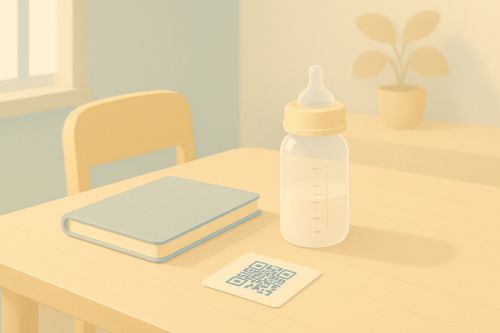
When Léo's head tilts for a few seconds at the childminder's, a label in his school bag stops the panicked call to his parents
The QR code is not an emergency trigger. It helps the childminder, the babysitter or whoever looks after the child regularly to understand the syndrome, to know what rest he needs, what reassures him, how to talk to him, how to include him in everyday play. She also knows who to call about anything she notices and wonders about, not to improvise a medical judgement, but to keep a relationship of trust going.
This case concerns a preschool-age child being treated for West syndrome (a form of epilepsy that begins in early childhood), under regular medical follow-up, who spends his days in childcare like any other child.
The moment itself
You are leaving your son Léo, 5, for the first time with a new childminder, Nadia, registered with the local authority. You briefly explained on the phone that he "has a form of epilepsy called West syndrome", but you know that the word alone says nothing about what it changes over a day of childcare.
You slip his QR code into his bag, with a handwritten note: "Nadia, take 3 minutes to scan this. It is what I would say to anyone looking after Léo for the first time." That evening she gives you a precise, warm account of the day: Léo napped longer than expected and she let him, they drew, he had no particular episode. The conversation gets going without your having had to "warn her about everything" in the ten minutes at pick-up.
- You write it
- The QR is in place
- The reader scans
- Understood, without explaining again
Where to place the QR code for this case
The aim: that whoever is looking after the child can read the profile calmly, several times if need be, rather than waiting for a crisis to discover the information.
- A label inside the childcare bag, printed at home from an A4 sheet.
- A card in the shared record book kept with the childminder (next to the health record).
- The QR code also sent as a photo to the childminder when the contract is signed (so she can read it at home, unhurried).
Intended audience: the people who look after the child on a regular basis (childminder, registered carer, a regular activity leader at the day centre, grandparents who look after him often).
myHandiQR does not replace any medical protocol. Whatever has to be done during an epileptic episode must be set out with the child's neurologist and passed to the childminder in a separate medical document (PAI, prescription, dated and signed instructions). If anything unusual happens during childcare, the childminder contacts the parents first, then 15 (the French medical emergency number) if she sees immediate danger.
Ready to use text templates
The sentences below are a starting point to help the childminder get to know the child she looks after day to day. They are not medical instructions, they are markers for a relationship.
For the "About me" section
"[First name] is [age]. He has been treated for West syndrome since [year], a form of epilepsy that begins in early childhood. He continues his regular follow-up with his neurologist. He likes jigsaws, pop-up books and playing shop. He speaks in short sentences, and he is happy when an instruction is calmly repeated to him."
For the "How to help" section
"You can: stay calm and speak gently (he is sensitive to commotion), get to know the favourite games that reassure him (noted in his bag), keep to the rest times you have been told about (he tires more than children of the same age), call us during the day about anything you are wondering about, no need to hesitate over a small question."
For the "What to avoid" section
"To avoid day to day: over-stimulating him when he is tired (late morning, after his nap), forgetting his comfort toy or his familiar object (a source of calm), changing the order of his day abruptly (he likes routines), trying to read a physical sign as the sign of a seizure (that is our job with the neurologist, not yours, your part is to observe and describe)."
Conditions involved in this case
This case relates to West syndrome, a form of epilepsy that begins in early childhood and comes with regular neurological follow-up. It also concerns other childhood epilepsies diagnosed early, where the main thing on the childminder's side is to understand the child's pace and needs day to day, rather than to improvise a medical response.
Similar cases
Other situations where a child left with someone outside the family circle should be welcomed with clear markers about his needs and how he works, written once at a calm moment rather than summed up in three minutes at drop-off.
The teacher understands, right when marking, why the handwriting is difficult, without the child having to ask out loud for leniency.
View the case Autistic child (ASD level 1), age 7 Reader: Substitute teacherThe substitute can access the sensory triggers and routines without any written handover, and without singling the child out in front of the…
View the case Child with ADHD, age 11 Reader: AESHThe support assistant has the right strategies from day one, with no trial and error and no extra meeting.
View the casePrepare your profile for this situation, without having to explain it again every school year.
You write down the essentials once. The grading teacher, the AESH (a teaching assistant for students with disabilities, in France), the substitute scan and understand. You stop repeating yourself.